


One addition to our July newsletter is sharing some memories of former Representative Karen Clark. We were truly saddened to hear of her passing on the last day of Pride month, as one of the longest serving openly gay state legislators in the United States. In her first year in 1981, she introduced the gay and lesbian human rights bill with Allan Spear, which eventually passed as part of the Minnesota Human Rights bill in 1993.
Karen Clark graciously held a meeting with Community Power back in 2016, as shown in the photo.

Pictured from Left to right: Tim Springer (former board member, Lee Samelson (energy democracy staff), Rep. Karen Clark, Marcus Mills (board member), Alice Madden (energy democracy staff), Eric Immler (committed volunteer)
She also shared a moment with us as we brought in Mr. Monopoly (in a costume) to greet additional legislators right before a committee meeting in 2018 on a bill that ultimately didn’t pass that we had dubbed the Nuclear Blank Check bill.

Particularly notable is that Karen Clark’s campaign literature from the year when she was first elected in 1980 included appeals to local renewable power. Environmental justice, particularly in her home neighborhood in East Phillips, became a core issue for Karen both within and outside of the state legislature.
One of her signature achievements was the 2008 Clark Berglund law, which requires the Minnesota Pollution Control Agency to analyze and consider the cumulative levels and effects of past and current pollution from all sources before issuing or renewing industrial permits in highly polluted, frontline areas. At numerous community events Karen Clark could be counted upon to display her a flip chart illustrating cumulative pollution and used the law she passed to help defend the Phillips neighborhood from projects that would impose further pollution.
After her retirement from legislature, Karen Clark still visited the state capital, as well as numerous occasions in Minneapolis, to support a shared vision to transform the Roof Depot, a former warehouse, into an urban farm and community hub. She lived to see the day when the East Phillips Neighborhood Institute acquired the Roof Depot site from the city.
In her work with the Women’s Environmental Institute, she helped bring in national leaders such as Will Allen to give trainings on re-localizing food production to the twin cities. Also under the WEI banner, Karen could be found selling produce at the Mill City Farmers Market right up until mid-June of this year.
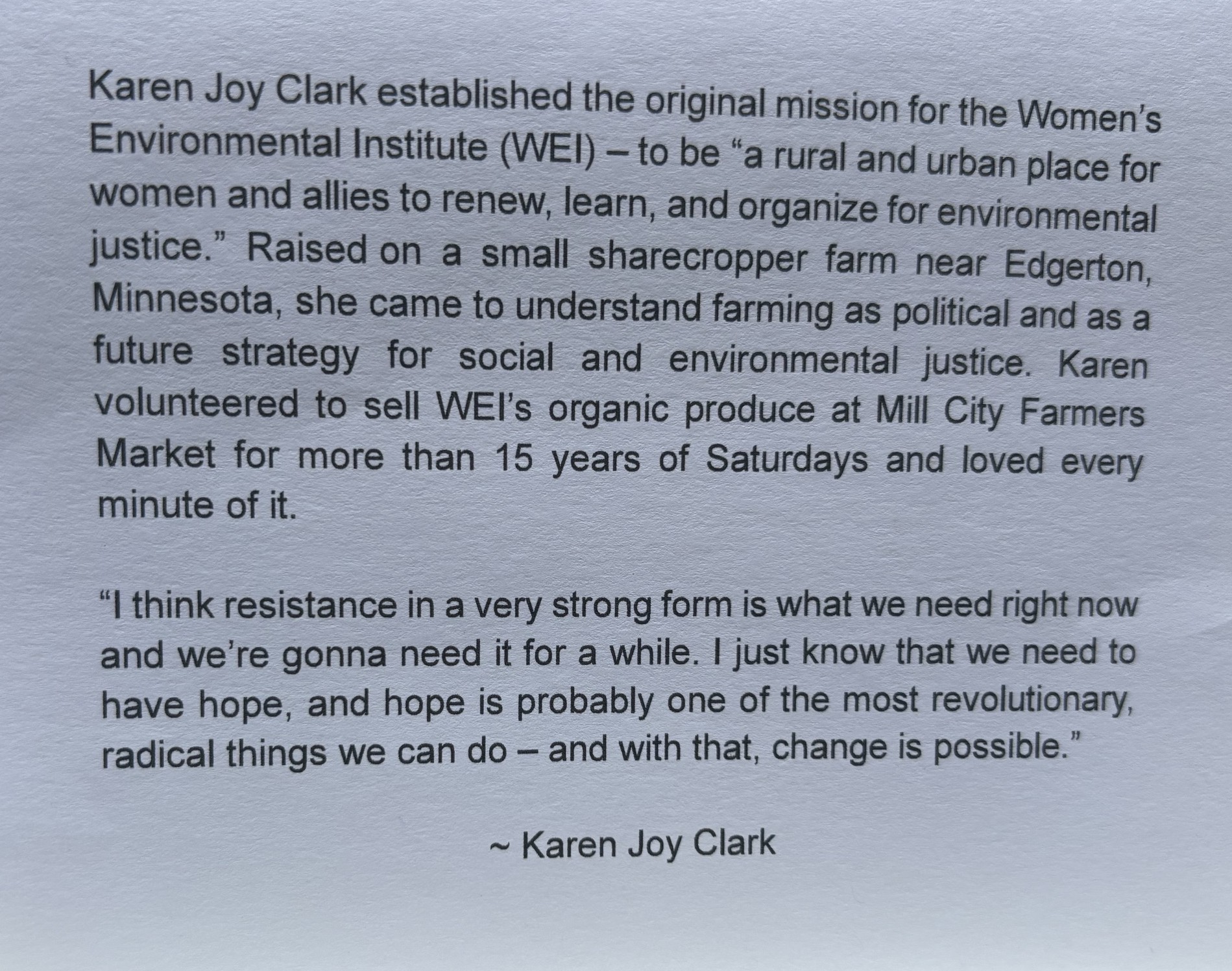
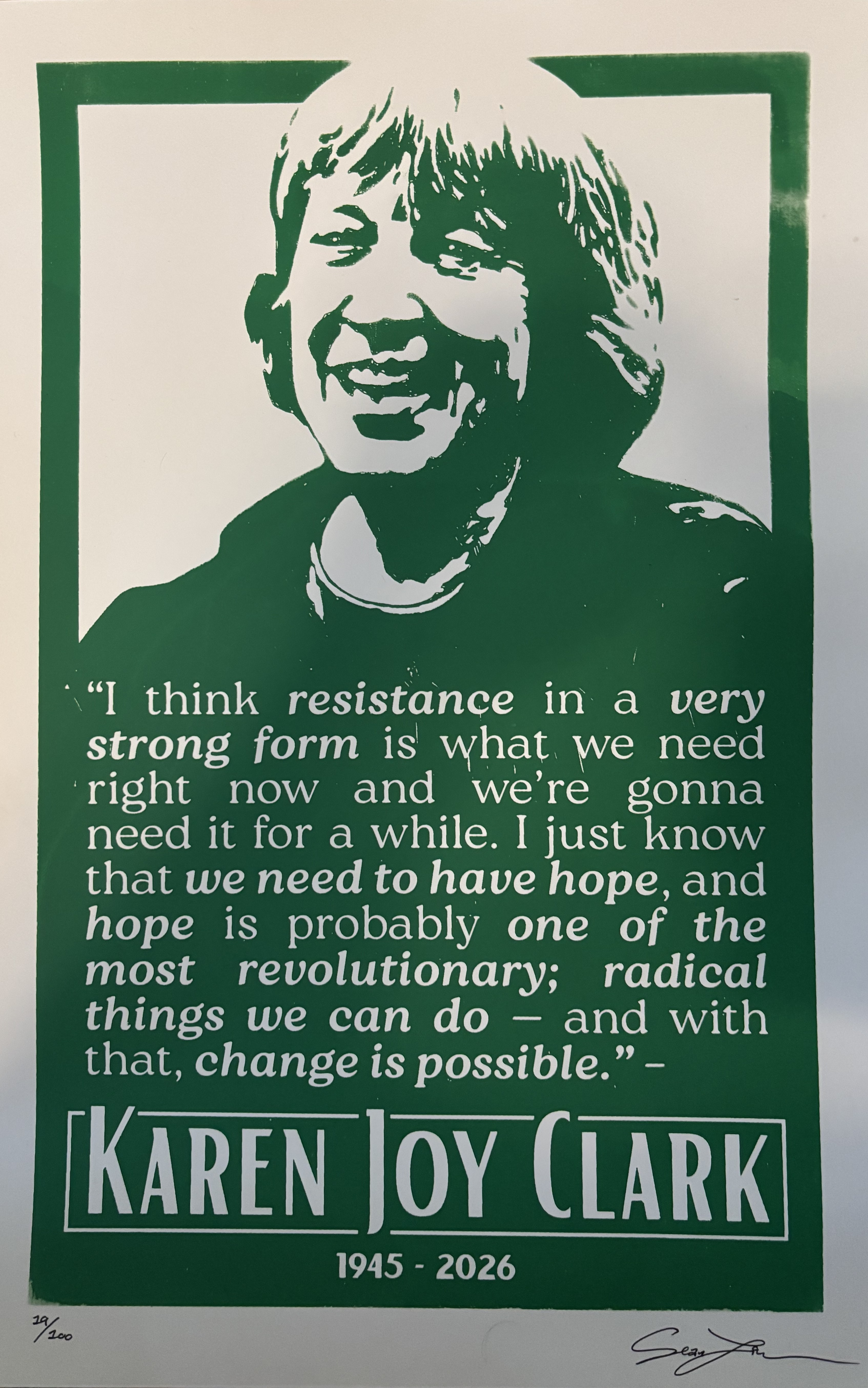
There was a memorial to Karen Clark on July 25th at the Mill City Farmers Market which included this brief bio above as well as artwork of her quote by Sean Lim who also helped our Good Energy Connections program with graphics design.
Karen's memory will continue to inspire in coming years.
In this issue:
- Our 2-page Resource Guide for Candidates (and voters) on Local Renewable Power in Minnesota
- A Fond Farewell to our Co-director, Brian Krohnke
- New Blogpost on June 25th Data Center Event
- The city's next steps & what you can do
- Federal anti-wind, pro-coal policies will add $650bn to our energy bills in the next 15 years
- Which is why it is important for states to act on energy affordability
- Candidate forums & Tabling Event this Saturday
- Update on the HERC incinerator
- Youth Organizing Opportunities
Help Elevate Energy Democracy into an Issue this Next Election
While Community Power does not endorse candidates for office, we have not been sitting idle.
Please share far and wide:
The 2-page Resource Guide for 2026 Candidates from the CLEAR Energy Coalition
CLEAR is an acronym that stands for Clean, Local, Equitable, Affordable, and Resilient energy. The coalition includes Community Power and 7 other Energy Democracy advocacy organizations.
Let it be known that local clean energy, notably rooftop & community solar:
- Saves money for all Minnesotans through avoided grid costs.
- Is the quickest source of new energy to build, making it essential for meeting our 2040 carbon-free electricity goals on schedule and meeting our growing energy needs in general.
- Is popular with voters according to polls.
- Helps make the electric grid more efficient, reliable, and resilient.
The Resource Guide makes the case on the above points and more by offering an abundance of links.
We conclude with debunking the common cost shift myths that utilities have used to try to undermine rooftop and community solar. Remember, the myth has it that non-solar customers subsidize others that install solar panels, and it just isn't so.
In addition to protecting net metering policies for rooftop solar and community solar, the CLEAR Coalition has advocated for this legislation that we have shared about in recent newsletters:
- Establishing a statewide Virtual Power Plant Policy that would be more open and give more choice for customers than what Xcel is willing to offer.
- Enabling Plug-in Solar in Minnesota, to make solar more accessible, equitable, and affordable for renters and low-income.
- Protecting utility customers by restricting monopoly utilities from spending ratepayer funds on astronomical CEO salaries and self-serving PR efforts and lobbyists.
- Promoting instant permitting, to make it cheaper and faster to build rooftop solar.
With the help of some of the CLEAR coalition organizational partners pictured below, we have offered meetings to every candidate for Minnesota governor plus a few dozen running for competitive state legislative seats where we included the CLEAR Energy Coalition’s two-page 2026 Resource Guide in our invitation emails. We have met with candidates running under the banners of the DFL, Green, and Republican parties.
Community Power has experience meeting with and educating candidates for mayor and city council in every Minneapolis local election from 2013 through 2025. This is our first year helping run a parallel process for state level candidates. That is because now more than ever, state action is needed to address energy affordability (read on).
Please Donate Now - Small Climate & Clean Energy Nonprofits Need Your Support More than Ever!
A fond farewell to our second co-director
Our Co-Executive Director, Brian Krohnke, is moving on from Community Power after 2+ years on the job. We wish him the best of luck in all his new endeavors and hope he stops by from time to time to say hello and shares interesting connections as he has always been so eager to.
As Brian continues to assist us in ensuring a smooth transition, we have yet to say "goodbye," but understand that people and opportunities change.
Best to you Brian!
Our New Blogpost on the Data Center Event
Please catch the latest in our new blogpost on the June 25th panel on downtown data centers moderated by Minneapolis City Councilmembers Rainville (Ward 3) and Shaffer (Ward 7).
For anyone new, we have shared the unfolding story of the data center debate entering the Minneapolis local sphere in our May and June newsletters.
This is a focal point for energy democracy because data centers are such intense electricity consumers. But that is not the only risk for surging emissions. Building a data center is also quite carbon intensive.
The June 25th Community Conversation offered a way to learn the messaging points of some who have been speaking in favor of developing new data centers in Minneapolis, though seemingly only specific to downtown. We heard convincing arguments for locating small data centers in the basements of under-utilized downtown buildings and as a tax-base-building tool for a city in a budget crunch. But most of the rest of the messaging points were various ways of saying that the common concerns about data centers should not apply here in Minneapolis.
Earlier the same day, the city council passed on a 7-5 vote a moratorium on data center development (that specifically exempted downtown and under 350,000 square feet and) that only lasts until November 21st, unless the city council votes to extend it.
This pause is, in our view, valuable so that developers can’t sneak in data center projects before the city has a chance to update their telecom infrastructure regulation and zoning codes for the new type of data centers.
Big tech has been attempting to ram through data center projects in multiple municipalities in Minnesota by using Non-Disclosure Agreements (NDAs) that forbid local officials from even talking about the projects and has successfully lobbied to block a ban on the use of NDAs in Minnesota.
What do they have to hide? That is the antithesis of Energy Democracy.
Next Steps for the City and what you can do
The fact that there was still opposition to this pause despite 3 huge compromises evokes suspicion and a pair of questions: Who is so intent on building new data centers outside of downtown that they could not wait another few months and if so, what parts of the city might they have their sights on?
What you can do:
Are you interested in joining a base building organization who is planning to do geographic organizing (involving neighborhood association outreach, canvassing/ door knocking) in parts of the city that are suspected to be sites for new data centers and coalition work (involving labor unions/ environmental orgs) on the topic? Come to attend the next working group meeting:
Tuesday, July 21st from 6:30-8PM @ the Twin Cities DSA office at 2708 E. Lake St. Suite 204.
As shown in the timeline below, the city council has a goal of passing a regulatory framework for the new types of data centers at the November 12th council meeting.
The city council has also passed a staff directive to a team of researchers paid by the city to report back on their findings, no later than August 18th to help inform this legislative process. It will be followed by a 60-day public comment period and a public hearing on October 13th.
The first part of the timeline happens this afternoon as the Minneapolis Planning Commission will be meeting July 16th at 4:30 PM about a zoning code text amendment on data centers.
Former City Council Member Cam Gordon and his policy aide, Robin Garwood, discuss this in their podcast Mill City Hall: Data Centers, Office Conversions and the Vacancy Dilemma.
The Work _______________________________________________________________________
Advancing Energy Democracy
Organizing our efforts to maximize impact and drive change.
Anti-wind, pro-coal policies will add $650bn to Americans’ energy bills during the next 15 years.
Why state action is needed to address energy affordability.
It has been one full year since the passage of a federal reconciliation law (remember the OBBBA?) that sent an array of tax credits for solar and wind power into the sunset.
So how are things faring?
Blue-Green Alliance research has found that more than 3,034 manufacturing, clean energy, and industrial sites face tax restrictions due to the legislation, putting at risk $695.2 billion in capital investment and 1,184,996 jobs.
Here is important context for evaluating any additional updates: The clean energy that we have on the system already has helped us avoid a heat-wave induced meltdown of the grid like the one we saw in August 2003.
In addition, offshore wind has actually helped New England beat record heat in recent weeks. This anchors the fundamental importance of clean energy as substantial and not "alternative".According to a recently released report by MIT, the trajectory of the clean energy transition in the electricity sector laid out in the Inflation Reduction Act hasn’t been totally squashed by these rollbacks of clean energy policies through executive actions, regulatory reversals, and legislative changes. The U.S. clean energy buildout is still advancing under the sheer weight of market demand.
Despite tariffs and interest rates increasing the cost of renewables, the latest Lazard Levelized Cost of Energy report finds that wind and solar nevertheless remain the lowest cost new build sources of power as all forms of energy get more expensive.
But here is what's lost. These rollbacks will increase household costs for electricity and fuel by an average of $460 a year by 2035.
That is largely because coal-fired power plants will retire more slowly, and the natural gas plants will run more often than they would have needed to.
A new analysis from the nonpartisan think tank Energy Innovation found these changes starting in January 2025 will:
- Add $650 billion in additional energy bills by 2040,
- Slow economic development and job creation,
- Increase air pollution and healthcare costs, and...
- Will worsen grid reliability.
Claims that dismantling an array of clean energy incentives would reduce costs for American families is yet another "Big Lie" repeated so often that it is passively assumed rather than actively questioned.
We have seen the use of coded language referring to maximizing domestic fossil fuel extraction, such as, “unleashing domestic energy production” and “freeing the economy from burdensome regulations” as an attempt to make some supply-side argument for how to lower energy prices. But it is completely illogical to talk about that as if it were the same thing as slashing an array of federal support for renewable power. It is extremely misleading to claim that the latter would thereby lower energy prices.
At a time when electricity demand is accelerating, how does it make economic sense to discourage investment in the ever-cheaper, fastest-growing sources of new energy?
Rather than “cheaper, more abundant energy”, such shortsightedness will leave Americans paying more due to simple supply and demand.
For example, Ohio’s government has blocked a lot of wind and solar projects that could have easily been built and met spiking energy demand. Now its residents are paying the price with their power getting cut off as energy costs surge.
It is parallel to another big lie that slowing automobile efficiency improvements and reducing competition from electric vehicles would somehow lead to lower gas prices. That would push gasoline prices higher over time simply because it increases demand for a resource that is nonrenewable and will eventually be depleted and become scarce and more expensive.
These rollbacks are not “freeing the market” or ringing in “freedom” but are much closer to the exact opposite. They are forcing higher power bills on us by blocking competition from clean energy projects to pad the wallets of a tiny handful of fossil fuel barons who want to dictate our energy future– all while using billions of our tax dollars to do so.
The federal administration plans to build two new coal plants — the nation's first in 13 years — that would cost nearly $20 billion if outfitted with carbon capture technology as planned.
We have seen $2.7 billion of our tax money go to smash wind power and $1.13 billion of our tax dollars go to prop up coal power (which is now the dirtiest and now most expensive fossil fuel) - as reported in the Guardian.
Citing national security threats over drone fears, the administration has delayed 155 new wind energy projects across 24 states, and the Pentagon has not revealed when it will resume permitting. The industry says it's pure politics.
Slowing down electrification and domestic clean energy manufacturing and construction will result in $2.3 trillion cumulative lost GDP and will cost the United States more than 800,000 jobs annually, the report also found.
That is ironic in how for years, operatives who profit from fossil fuel dependency have waved the flag of job losses in traditional energy industries to justify opposition to a clean energy transition. Our partners in the clean energy and climate justice movements have made intentional efforts to respond to these concerns by laying out win-win clean energy transition pathways to generate new jobs or economic opportunities for fossil-fuel-dependent communities. Have they shown any comparable care or concern as the cancellation and downsizing of hundreds of clean manufacturing and energy projects have jeopardized nearly 500,000 jobs?
And it is not just about higher electric bills and lost manufacturing jobs. Having more soot, smog and air pollution than we would have otherwise had will increase healthcare costs by $43 billion ($4 billion a year by 2030). This is not some “externality” that will simply disappear into economic nothingness. It means thousands of additional premature deaths. Intervening in the market to keep coal and gas plants going longer also requires a completely brutal dismissal of how climate change continues driving record heat, floods, and wildfires.
In regard to national pride around the 250th anniversary of the signing of the Declaration of Independence, there is one last consideration to top it all off. How is it somehow a mark of national pride to let other nations win the contest to dominate the industries of the future? Without a course correction, tomorrow’s energy economy is on track to be built somewhere else. How is it patriotism for the US to lose out on where the factories will be built, where supply chains will develop, and which countries will capture the investment, jobs, and export markets?
This heat wave reminds us: We have no time to lose on climate
- ... and we know what must be done.
- By Satish Desai, Minnesota Reformer. July 14th, 2026.
Community Power channels its expertise into three focused program areas. By addressing challenges at the state, city, and grassroots levels, we’re building a sustainable and equitable energy future for all.
Events & Forums:
Community Power will be tabling as Good Energy Connections at the Safe & Sound Summer Festival in Peavey Park on Saturday, July 18.
Minneapolis School Board at Large Candidate Forum -Thursday, July 16, 6-7:30pm, Minneapolis Central Library, Pohlad Hall, 300 Nicollet Mall, Minneapolis, Livestream: https://www.youtube.com/live/Msq_kMSMxsc
Check out these recording of recent League of Women Voters Forums:
Another Upcoming Candidate Forum:
If you would like to submit a question for the candidates, please use this form.In other news...
Environmentalists sue Hennepin County over ash from HERC trash incinerator — By Andrew Hazzard, Sahan Journal 7/7/2026
- An environmental law firm says Hennepin County is failing to follow a state law requiring plans to make ash from its garbage incinerator less toxic. The suit comes on the heels of a hunger strike against the HERC incinerator.
$5,000 in youth organizing grants
The 2026 Youth Power Fund is an open call funding opportunity for youth organizers and youth-led organizations across the country who are looking to make an impact in this pivotal year.
They are making grants of up to $5,000 to invest in local political and cultural organizing, especially in BIPOC, LGBTQ+ and disability communities.
Apply here by July 31st.
Here’s a social media toolkit you can use to spread the word!
The Youth N'Power Network is having a webinar featuring young leaders sharing their personal journeys into the environmental field. You’ll hear firsthand about their experiences navigating school, careers, advocacy, and the transition into becoming professionals.
Whether you're interested in climate justice, community organizing, conservation, or exploring career opportunities, this conversation will offer honest insights, perspective, advice, and encouragement from young people.
Come connect, ask questions, and learn how you can build your own path in the environmental movement.
Click here to RSVP!
Job Boards:
- ReUse MN
- Clean Energy Resource Teams (CERTS)
- MN Council of Nonprofits
- MN Environmental Partnership
- City of Minneapolis
- The Circular Action Alliance (jobs created by MN passing a "producer responsibility" law back in 2023-2024.)
- Young Professionals in Energy
Open State Advisory Positions:
- Energy Transition
- Electricity as Fuel
- Investments Board - (influences how our state invests $$)
- Workforce Development
Join Us in Building a Better Energy Future.
Together, we can create an energy system that works for everyone. Ready to make an impact? Visit our website at www.communitypowermn.org or reach out to us directly today. Let’s create change—together.
Lee Samelson, Alice Madden & Brian Krohnke


Latest
July 2026 Newsletter and Tribute to Representative Karen Clark
Posted by Lee Samelson on July 27, 2026
June 25th Panel Reveals Pro-Data Center Perspectives That Will Be Used In Minneapolis
Posted by Lee Samelson on July 14, 2026
Electric Democracy & Questions on Data Centers for Minneapolis
Posted by Brian Krohnke on June 26, 2026
MN PUC maintains 34 million in subsidies for gas line extensions
Posted by Lee Samelson on June 12, 2026