
In 2025, the issue of skyrocketing energy utility bills started to go mainstream. To put a number to it, in 2025, we saw $34 billion in utility rate increase approvals and requests in just the first three quarters. Because many of those were only rate hike requests, a whole lot of increases still have yet to hit people’s utility bills. To put it in a perhaps more understandable numerical perspective, our energy bills have already increased by about 30% since 2021. Rising energy prices are among the fastest drivers of inflation.

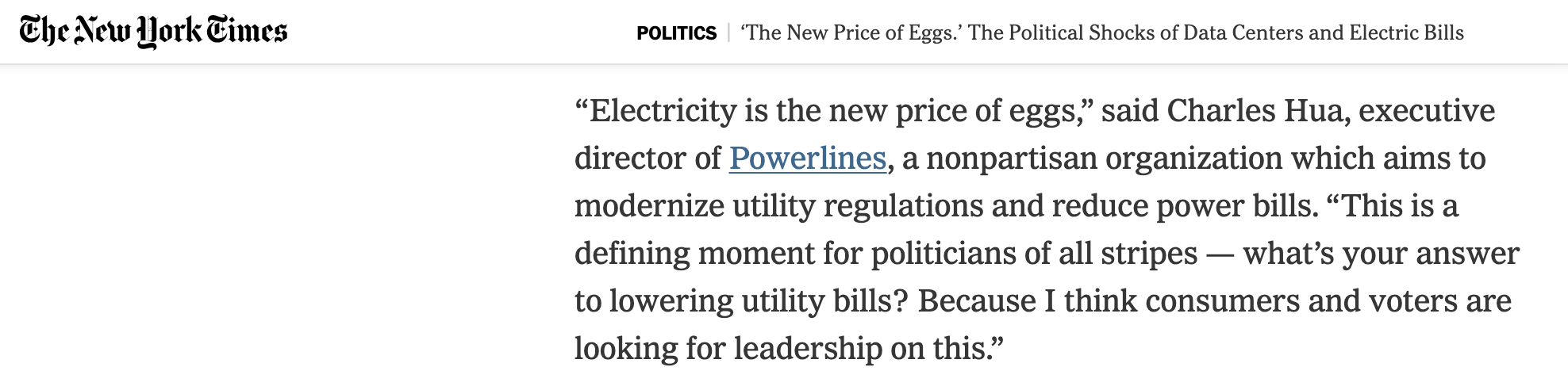
“Electricity is the new price of eggs” has become memorable quote from Charles Hua of consumer advocacy group PowerLines, expressed in a recent NY Times Article


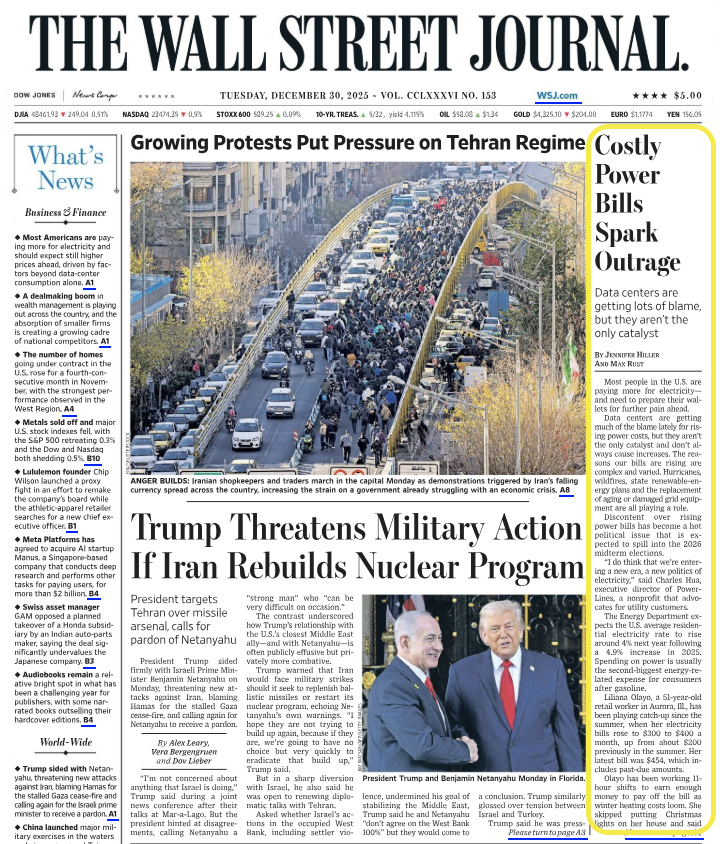
Electricity prices are rising and have been rising at more than twice the rate of inflation over the last year, becoming a major driver of a worrisome broader cost of living crisis.

That phrase captures how most Americans feel this trend happening, and are becoming concerned. It is a phrase that encapsulates how American consumers, and voters, hate higher prices and how people respond viscerally to utility-bill discussions. It has already had political ramifications shown in recent elections of utility regulators in Georgia where two candidates who promised a focus on affordability and ​“clean, reliable energy” unseated 2 Republican incumbents on the regulatory commission that oversees ratemaking for the state’s utilities. That was the first time in at least 20 years when incumbents were ousted, and it was due to backlash over utility bills that had risen over $500 a year for the average Georgia household.'
Despite President Donald Trump campaigning on bringing down energy costs with additional frequent promises to do so, his energy policies are are actually making an already bad situation worse.

On his first day in office,  he declared an ​“energy emergency,” based on one grain of truth that Americans faced an ​“active threat” from high energy prices. But he used that ​“emergency” to keep coal-fueled power plants open past their retirement dates after a many years when the coal industry had been on the way out.  This came at a great expense to ratepayers. 

For example, a Michigan coal plant that was supposed to shutter in May instead racked up $650,000 each day in costs for ratepayers after the Department of Energy ordered it to keep running.

Renewables and battery storage are a cheaper and quicker way to get more new power to come online. Clean renewable wind and solar are the quickest forms of new energy supply to build when more generation is needed, and are also the most affordable forms of new power to add to the system. But the Reconciliation Bill which Trump signed in July, scraps tax credits for not only such solar and wind deployment but also incentives for home energy improvements that directly result in lower utility bills. Also driving the crunch for cost-burdened households has also been a delay in the distribution of federal home heating assistance, spurred by the government shutdown. Natural gas bills too are expected to rise.

It is disingenuous to claim “we need to do X, Y and Z coal and gas plants open because of “energy affordability” and "Coal and gas the ​affordable and reliable domestic supplies of energy that the US needs simply because I said so" while the other hand scheming up even more plans   to make even more cuts to the exact same federal programs that help households reduce their energy usage and bills, such as Energy Star and the Weatherization Assistance Program.

The federal government confiscating clean energy incentives and funding while making a renewed commitment to fossil fuels (including coal) will only make our utility bills climb even further. With fewer cheap, affordable clean energy projects being built, the average American household will pay $170 more each year for energy than they do now by 2035, according to the think tank Energy Innovation. So therefore, these federal rollbacks, that will limit us to building only about half of the clean energy previously planned, are a lose-lose proposition for both affordability and our climate.   

It is basic simple-to-explain economics. Suppressing our ability to increase electricity supply at a time when electricity demand is going up, largely because of data centers and AI, will lead to higher prices.   

In addition to the new energy-guzzling data centers being built to train and run AI models, we have beneficial electrification of gas appliances and additional manufacturing input.  

While there are many directions that we can take this information, here is one course of action to take into account.   

We can pay less if state legislators and utility regulators seize the moment and act in the interest of consumers — rather than the shareholders of utility companies.

These regulators are small decision-making bodies, known as state public utilities commissions, who play a powerful role in shaping our energy future and determining what people pay on their utility bills. Because we are still locked into outdated incentives set in place in the earlier 1900’s, there are a few main points to be aware of that they don’t teach us about in schools: 

  1. Investor-owned utilities receive guaranteed profits by the state. 
  2. The more the infrastructure utilities build, the more profit they make. Utilities really like to build new things because that is what they are incentivized to do, while regulators are supposed to ensure that they don’t build unnecessarily.
  3. If regulators allow utilities to make a certain big investment in the grid or and the demand for it doesn’t materialize or builds a new power plant that does not end up functioning, then ratepayers—i.e., everyday consumers like you and I—are legally on the hook to be left paying for it.
  4. Most utilities are monopolies in their service territory, meaning that customers commonly have no other choice in where to buy electricity from.  

So therefore, state regulators (in Minnesota, the Public Utilities Commission) are the ones who are in charge of 

#1 Setting the rate of return the utilities can make,

#2 Setting the rates that the energy utilities charge customers, and

#3 Approving or denying which infrastructure project expenditures utilities can build, as to whether or not they are in the public interests.

These are important safeguards against monopoly utilities gold-plating us and price-gouging customers who have no other choice in where to get their electricity from.   
 

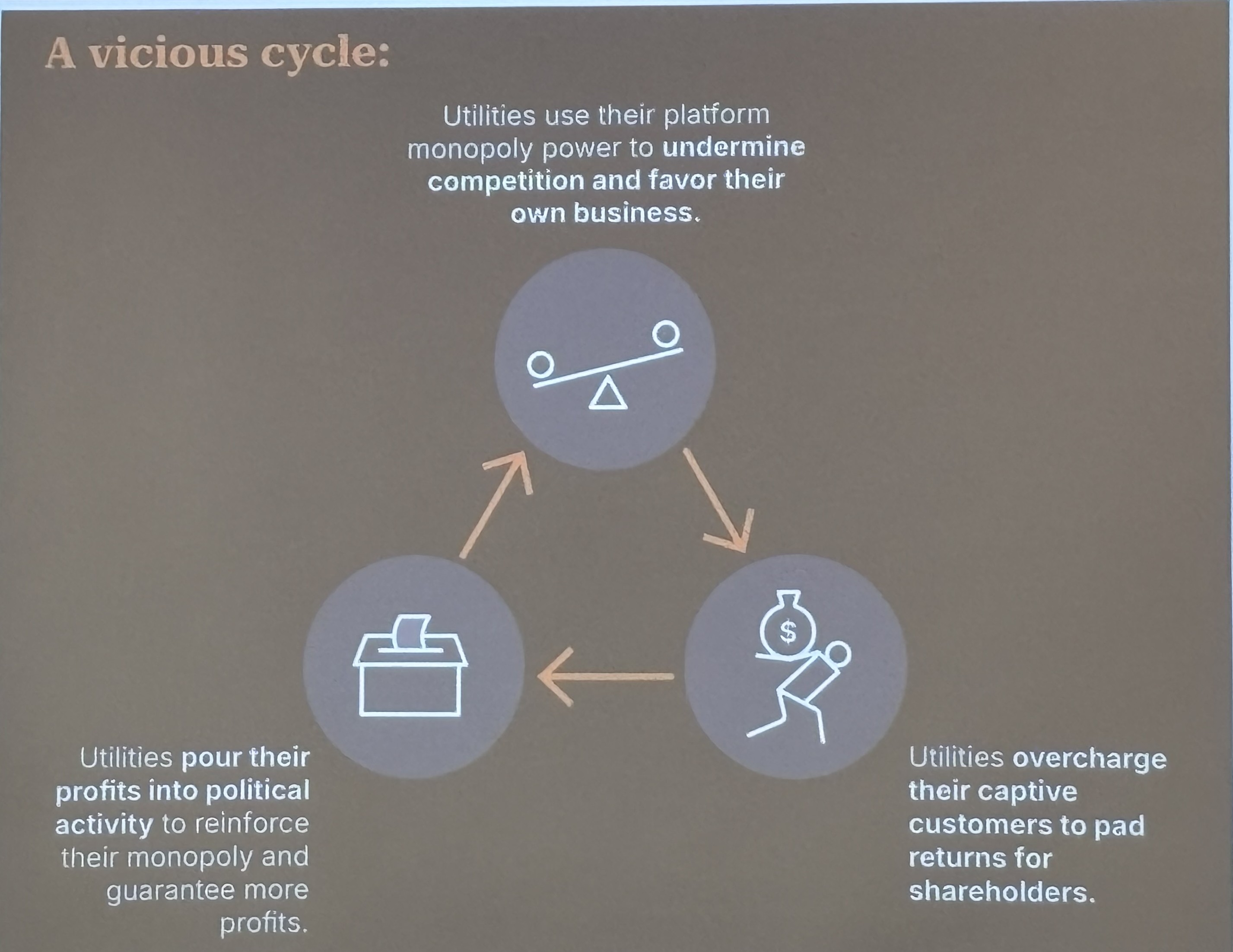
The main course of action is that there are 3 ways policymakers could act to lower electricity bills now (without needing help from the federal government):


  1. Cut excess utility profits (along with their inflated executive and shareholder pay).
  2. Stop regulating utilities like it's 1920! Reward utility companies for boosting efficiency, not just for making capital expenditures. 
    • We could significantly reduce electricity use through energy-efficiency investments that routinely cost less than building fossil-fuel power generation that are favored by most utility interests.
    • According to most analysts, the main or major culprit behind high electricity prices is excessive utility spending on transmission and distribution infrastructure at times when cheaper upgrades to existing poles would suffice and be more affordable for customers. 
      • Why is this the case? The utility’s overemphasis on building unnecessarily expensive new high voltage transmission line infrastructure is a result of this outdated “the more they build the more they make” incentive. If every grid problem is a nail, the utility wants to use a gold-plated hammer to “solve” it.
  3. Unleash local solar power & storage (along with a whole suite of cost-saving, community building ways we can use distributed energy!) 
    • Local renewable power + battery storage saves everyone money because it provides electricity right where people use it. 
    • Dramatically scaling up rooftop solar and batteries will cut future grid costs by half a trillion dollars if it is given a chance. That is because it does not require new transmission infrastructure that is favored by utility companies because they get guaranteed profits for it (though costly to us but because we pay for it on our monthly bills). 
    • Another part of regulators taking bold leadership on affordable clean energy rather than being weak on utility oversight is to cut the red tape on permitting and interconnection for local solar projects including those with batteries. 


A growing sizable fraction of Americans are struggling to pay their utility bills, with the vast majority feeling powerless over what they can do to contain these costs. Trying to achieve a pathway to overcome that sense of powerlessness and helplessness has been the mission of Community Power from the beginning. It is in our name!

After years of Community Power organizing community education on the economics of the electric utility system that shed light on how the rates that we pay for electricity are set, we are finally seeing unprecedented engagement with policymakers on the issue. The topic of utility economics and the need for systemic transformative change in utility regulation is no longer the too-wonky-to-be-worthy-of-attention niche concern among energy advocates like us. While it has historically been challenging for the public to engage with policymakers on these highly technical, arcane issues, people across the board are paying more attention. Energy is no longer a sleeper issue to be cast aside until later in favor of more short-term matters. That is because later has now arrived and will continue to do so to an even greater extent.

Community Power and partners have long had an interest in countering what could be known as “the big lie” that renewable power has been or will be responsible for rate hikes. The fact that its expensive to maintain, expand, and repair the grid is closer to the ruth in what is really driving the rise in utility bills.

Because truly engaging in energy democracy can get technical, and because the basics of utility economics is an arcane issue that we are not taught about in schools, it has been a challenge to mobilize a critical mass among the public to engage with policymakers to chart the course of our energy future. But now, more people across the board are finally paying attention. We need to be ready to pounce on this opportunity so that the peddlers of misinformation can’t do so first. We can’t let the likes of the Edison Electric Institute – a trade organization for the utilities- to pounce on this opportunity with their solar cost shift myth that they concocted to try to get policymakers to tilt the playing field against distributed solar + storage. We also can’t let the utilities themselves pounce on this opportunity with their claims that they need huge profits in order to deliver more renewable power.

That creates a long-awaited opening for us to finally, after decades and decades, to modernize this outdated 20th century utility regulatory system that has too often centered the interests of the energy monopolies over consumers.

There is now a desire for an unprecedented level of public engagement on energy democracy issues and for the purpose of advancing innovative solutions that can bring down utility bills for consumers.

Energy utility bills are becoming a defining economic and political issue for this new year.

We have an abundance of opportunities to modernize our utility regulatory system with tackling rising utility bills providing the key motivation. 


Let's Take a Deeper Dive on Point #3 - Exposing the Utilities’ Solar Cost Shift Myth:


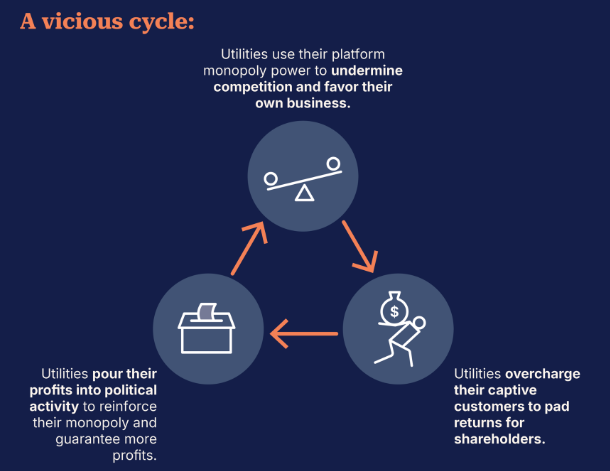
Utilities who cling to the outdated business model have a bias against rooftop and community owned solar projects that they can’t own, control and rate base and therefore can’t get that 9.25% guaranteed return on investment on it (which is the rate for Xcel in Minnesota). But rather than openly admitting this, they have fabricated the solar cost shift myth, an unfounded claim that rooftop and community solar customers shift costs onto other nonparticipating customers. 

Policy makers should reject the utilities’ so-called “solar cost shift” and instead partner with customers who have helped save ratepayers money by investing in rooftop solar. It is a win-win-win for carbon reduction, increased system resiliency, and reduced grid spending. Together we can realign energy priorities that work for investor-owned utilities – spending more on certain aspects of the grid- and toward what works for consumers – taking opportunities to spend less. This is particularly important if we are to increase electricity consumption due to beneficial electrification, even without increased demand from data centers and AI. We need more rooftop and community owned solar- not less – to control costs for all customers and to meet state level clean energy goals on time.

Utilities have fabricated this cost shift myth based on the concept of “departing load”. The utility lobbyists and spokespeople behind this claim that the majority of their costs are fixed. So when a customer generates their own power from on-site solar panels, the utilities claim this forces all other ratepayers to pick up a larger share of these “fixed” costs. That theory conveniently ignores how total electricity consumption has been offset by customer and community-sited solar. Those who peddle the utility-inspired solar cost shift falsehood would typically make claims along the lines of “rooftop and/ or community solar customers have shifted X amount of dollars to non-solar customers in the year YYYY” with the intention of misleading policy makers into assuming that these customers are to blame for growing overall costs. That provides a smokescreen to distract from what data shows are the real roots of the growing energy affordability crisis: the combination of runaway utility spending driven by utilities interest in increasing profit and lax regulatory oversight who have a tendency to rubber stamp whatever gold-plating the utilities want to pursue. Perverse and outdated utility profit motives motivate the utilities to spend ratepayer dollars inefficiently and unnecessarily. The same outdated incentive structure also leads utilities to fight customer owned rooftop and community solar as competition rather than a benefit and to cook up misleading falsehoods like the solar cost shift myth as a crowbar to try to fend it off.     

Utility spending on grid infrastructure is at a near 1-1 ratio to rate increases so the data points toward spending increases being the culprit behind higher rates rather than customers investing in clean energy. If the utilities costs were basically stagnant and rates continued to go up, that would suggest a cost shift happening somewhere. Or if rates have increased at a significantly higher rate than their spending increases, that would also suggest a cost shift.    

Rather than causing departing load, local and community owned solar offset load growth and actually helps utilities avoid unnecessarily expensive grid expansion projects and reduce generation expenses. That lowers costs for everyone, particularly at times of peak load in places where electricity consumption peaks in the mid afternoon on hot summer days (when the sun is shining). It means fewer gas peaker plants have to be fired up to meet air conditioning-led peak load moments.

Utility lobbyists and the regulators and other policy makers who have bought into their cost shift myth conveniently overlook these savings and like a magician who tells you which hand to focus on blames rate hikes on the customers who are seeking relief through rooftop and community solar. To truly address energy affordability means stopping scapegoating working and middle-class families who now participate in the renewable economy because they took the opportunity to make use of policies that make renewable power more accessible to a greater number – such as community solar, rooftop solar incentive and net metering. Instead, distributed renewable power equals meeting our growing needs for electricity.

It is important for our climate that we power our cars and appliances with electricity that could much more easily be decarbonized than fossil gas and liquid fuels. This brings us to an important crossroads since our overall electricity usage will increase dramatically if we do the right thing. If those in charge of carrying out energy policy are stubbornly clinging to the 20th century model of relying on vertical monopoly utilities to deliver energy from far away power plants and long-distance power lines, it would put us on the path to massive delays and costs rising even higher. Assertive deployment of local and distributed solar power can offset significant proportions of demand increase from beneficial electrification and to help keep costs under control in the future.  

Labeling solar generation from customers as a cost to the utilities is rooted in this outdated thinking that insists all customers should be obligated to buy their electricity from the utilities simply because that one-way set up is how things have been done in the past. That makes as much sense as punishing customers for energy efficiency because it results in buying less energy from the utilities, who still pay the full rates for the energy they still use.

In order to really unpack and debunk the solar cost-shift myth would mean to specify how the peddlers of this misinformation use a binocular trick when trying to measure solar costs and benefits. It involves exaggerating the costs while overlooking the benefits. You can’t fairly judge solar customers as “not paying their fair share” of the overall fixed costs if you only selectively look at some parts of solar customers’ bills and overlook the extent to how most solar customers still pay a monthly utility bill.  

Utility lobbyists and trade groups catapult this propaganda to bamboozle policymakers into passing laws intended to slow down and chill the market for community scale clean energy connecting to the grid and overall ways to tilt the playing field so steeply against local and non-utility owned clean energy that only the monopoly will be able to compete. In the past 2 years, the solar cost shift myth has persuaded the MN Public Utilities Commission to slash the bill credit rate for subscribers to early community solar garden projects. It has also led state Senators to threaten to end our entire community solar program and to pursue laws to undermine net metering. We need to instead respect the investments of rooftop and community solar customers, and changing the terms of their contracts mid-stream (like the MN Public Utilities Commission did) is unjust.

Propaganda has consequences. If policy makers and regulators operate from the assumption that the solar cost shift myth must be true, then it would result in them imposing an abrupt and extreme gutting of net metering policies - like we recently saw in California. That would, in simply stated terms, allow the utilities to steal power from solar customers without compensating them for it, where they get the privilege of hypocritically becoming the free riders that they falsely accuse the same solar customers have been. Such a course of action would cause massive layoffs of skilled solar professionals with long-standing solar businesses closing or going bankrupt- chilling the market for solar and setting it back years.

Latest

Dec

22

2025

Electricity is the New Price of Eggs

Posted by on December 22, 2025

In 2025, the issue of skyrocketing energy utility bills started to go mainstream. To put a number to it, in 2025, we saw $34 billion...

Dec

17

2025

2025 End of Year Letter

Posted by on December 17, 2025

Dear Community Power friends, allies: We won’t tell you that 2025 has been a doozy. We will say that despite the headwinds and rising authoritarianism...

Dec

13

2025

City Council Passes 4 Million in Additional Funding Focusing on Weatherization and Energy Efficiency

Posted by on December 13, 2025

By a 10-3 vote on December 11th, the Minneapolis City Council passed the Gas and Electric Franchise Fee Funding ordinances (2025-01061 and 2025-01062). Both are...

Nov

18

2025

Give to the Max Day!

Posted by on November 18, 2025

Clawback, recision, impoundment, f***#~!%, call it what you will! The feds have been clawing back support for environmental justice & community based clean energy projects in so...