
Electric Democracy & Questions on Data Centers for Minneapolis

Data Centers & Networked Geothermal Dominate Discussion of our Energy Future in MinneapolisWhile bipartisan support is a rarity these days, geothermal energy has it. In addition, America's backlash to data centers is also bipartisan (for now). A today will reveal the extent to which the Minneapolis City Council is divided on data centers. Later today on Thursday, June 25th, Minneapolis City Council Members Elizabeth Shaffer (Ward 7) and Michael Rainville (Ward 3) will be hosting a Community Conversation Event on the topic. One of the four panelists will include John Marshall of Xcel Energy, who currently serves on the Minneapolis Clean Energy Partnership board. Its purpose is to make good on Xcel's stated commitment to be "good partners" in helping Minneapolis meet ambitious clean energy and carbon reduction goals. Since data centers are energy intensive, a discussion is warranted on how we could avoid backtracking on our local Climate Equity Plan goals.
It will take place from 5:00–6:00 p.m. in the Public Service Building (505 4th Ave. S.), Conference Room 100AB. The event is free and open to the public and will be recorded. Other council members have also hosted public events on data centers, including Aurin Chowdhury (Ward 12) who is the author of the proposed temporary moratorium on building new data centers in the city. It has since been amended to last only six months with exemptions for projects in downtown and which are less than 350,000 square feet. See the slideshow that Chowdhury and Jason Chavez (Ward 9) put together and presented last week. Public Hearing on Data Centers Evokes Questions Related to EnergyThere was a robust public hearing at the June 16th Business Zoning & Housing committee, where Community Power staff and partner organizations spoke. There was an abundance of speakers both for and against the temporary moratorium.
(Community Power staff, Lee Samelson, showing an image to City Council of how the Minneapolis Clean Energy Partnership has set a goal for 100% renewable electricity community wide by 2030, of which we were only at 39% in 2024) The committee voted 5-1 in favor of advancing the temporary moratorium to a full city council vote on June 25th. Since all council members are in agreement with the directive to issue data center regulations by this fall, the work and discussion will continue regardless of how the vote turns out today. UPDATE: The amended 6-month pause passed the city council on a 7-5 vote on June 25th. While Minneapolis has the regulatory framework and zoning categories for older telecommunications infrastructure, the city has yet to update either for the newer types of data centers. The purpose of the six-month pause is to provide the city with time to accomplish that. But will it be enough time to answer these essential questions? 1) How feasible is it for upcoming data centers to be powered by their own new clean energy so that we could be compliant with Minnesota’s 100% carbon free electricity by 2040 and the similar Minneapolis Clean Energy Partnership goals? Remember, we, as in the collective we, are not on target to meet these goals as it is, and large new loads will make it even harder to achieve. 2) Can we get assurance that waste heat from data centers will be sent into thermal energy networks so that other buildings could use it? 3) Are the ratepayer protections that the MN PUC put in place enough to prevent the utilities from overcharging captive customers for the grid infrastructure investments needed to accommodate new data centers? 4) Since data centers are such outsized energy consumers, how can they safely run continuously during times of peak air conditioning load when the grid's capacity is stretched to its maximum? 5) What is the plan for the recycling of metal GPU components for when they wear out and need replacement? 6) To protect our water resources, is it feasible to require circular or closed-loop water management and adhere to strict heat discharge regulations rather than evaporative cooling?
(An active data center at 1001 3rd Ave. S.) Community Power Founding Board Member John Farrell, who has helped develop a policy framework for communities respond to demand for more data centers, is quoted in this article covering the story: City Council debates data centers. New City regulations likely coming this fall
“The fundamental moral question is this: AI is a technological bet by some of the richest people in the world who imagine growing their wealth by monopolizing its use,” said Farrell. “There’s no reason they can’t afford to design the computing power to fuel it in a way that minimizes community harms and maximizes community benefits.” |


|
|
|


|
|


The Work _______________________________________________________________________Advancing Energy Democracy
|
|
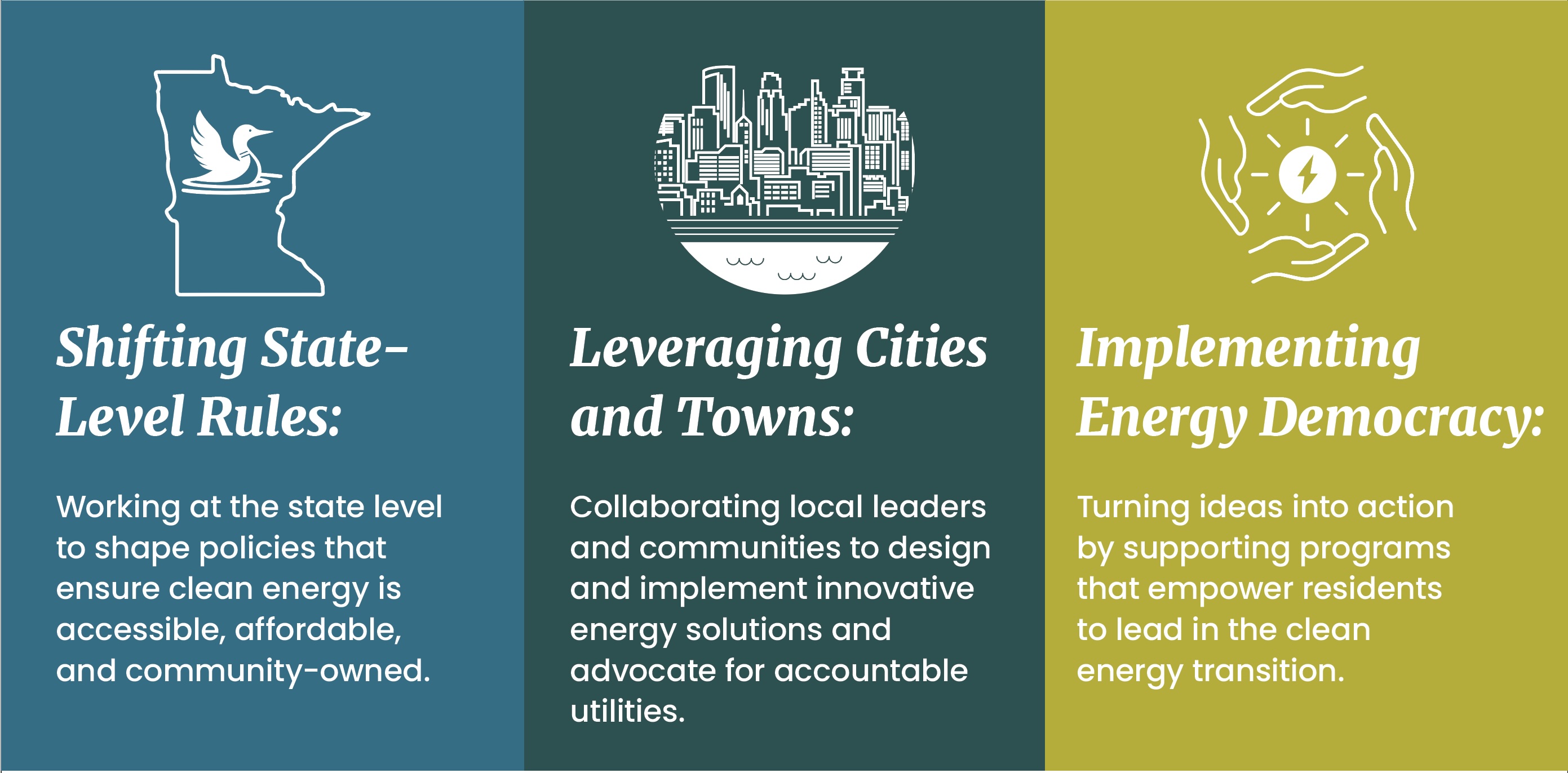
Community Power channels its expertise into three focused program areas. By addressing challenges at the state, city, and grassroots levels, we’re building a sustainable and equitable energy future for all. The MN Clean Heat Coalition mobilizes to end $34 million in subsidies for gas line extensionsWe cover this story and the resulting PUC decision in our recent blogpost.Should utilities still be allowed to charge existing Minnesota customers an estimated $34 million every year to extend gas pipes to add new customers to the gas system while also adding on a shareholder profit for those investments? Would ending that costly practice open the door to re-imagining and building a more affordable clean energy future where we are not tethered to the volatile cost of fossil fuels and growing utility charges? Partner organizations in the Clean Heat Minnesota coalition devoted months to organizing in-person comment writing workshops calling upon the Minnesota Public Utilities Commission (PUC) to end gas line extension allowances for that reason. The MN PUC disappoints yet another coalition effort.
At their June 4th meeting, the PUC approved some new limits on how far natural gas companies can extend lines for new customers, which one report characterizes as “nudging the system toward cleaner heating options”. Three out of five PUC members voted to maintain the line extension allowance policy for gas utilities, but now in a slight improvement, they will have to be disputed on a case-by-case basis. We think they could have gone further to limit the practice, because in order to reach Minnesota’s state goal of net-zero greenhouse emissions economy-wide by 2050 we need to phase out the gas system rather than invest in it further. As discussed in the previous article and elsewhere in our newsletters, new Thermal Energy Network systems will help to accomplish this gas retirement while protecting ratepayers if it is done in a collective and coordinated manner. Meanwhile in Colorado, we are excited to see an example of a PUC taking the side of clean & cheaper energy, denying a utility request to build out new gas infrastructure: |

 |
|
|




Inspirational Articles from Around the Nation:Solar beat coal on the US grid in May — a new milestone
Trump Administration Abandons Fight Against Wind Energy as Clean Energy Output Surges
Minnesota now has a wind-powered green ammonia plant
Former Utility executives re-indicted in Ohio in $60 million corruption scheme
Connecticut legalizes balcony solar installations
How one Oregon city has raised a billion dollars for climate change
Job Boards:
Open State Advisory Positions:
Join Us in Building a Better Energy Future.Together, we can create an energy system that works for everyone. Ready to make an impact? Visit our website at www.communitypowermn.org or reach out to us directly by replying to this email. Let’s create change—together and stay tuned for next month's newsletter. Lee Samelson & Brian Krohnke |


Latest
"What About St. Paul?" The New Franchise Agreement Arrives!
Posted by Lee Samelson on September 25, 2026
August 2026 Community Power Newsletter
Posted by Lee Samelson on September 02, 2026
Mayor Frey, City Council: Protect the new $4 million for low-income weatherization
Posted by Lee Samelson on August 25, 2026