

Rooftop and community solar save billions of dollars for all utility customers, from sea to shining sea. This has been supported by studies from West to East, from California to Minnesota, from Chicago to Washington DC:
-
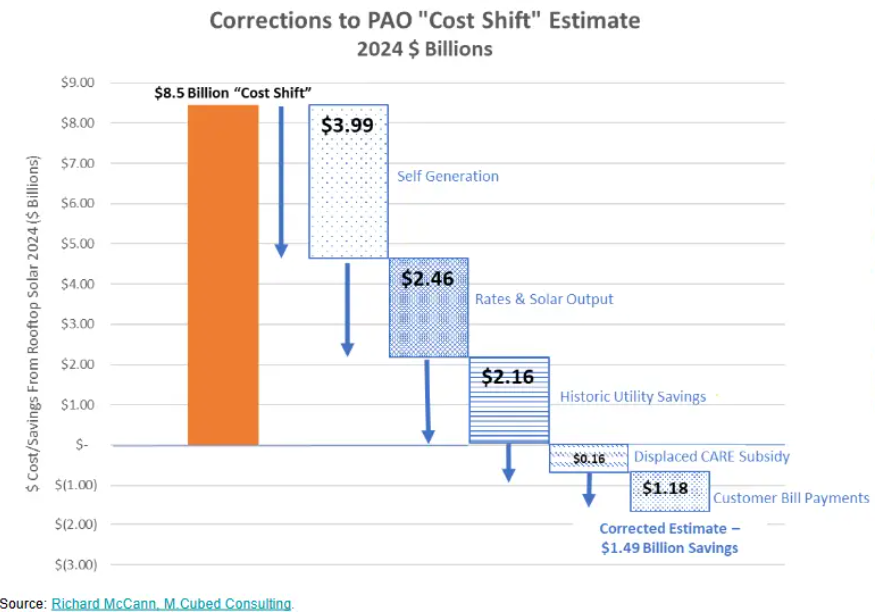
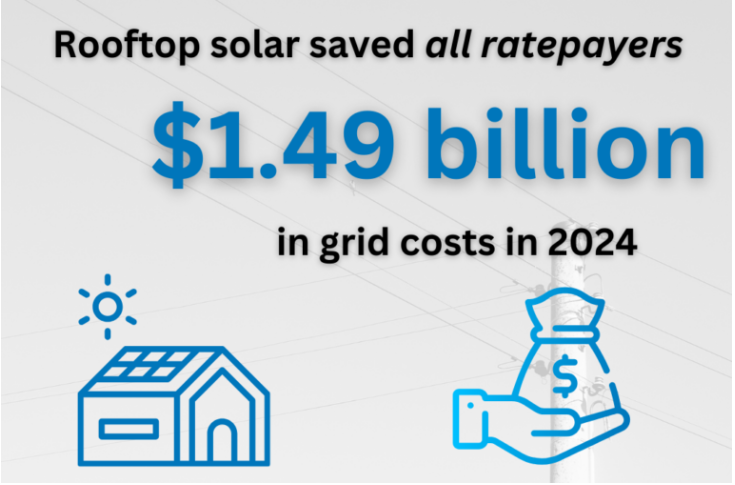
Dr. Richard McCann and researchers from M.Cubed Consulting released their blockbuster 2024 report that estimated that rooftop solar saved all California customers $2.3 billion on utility bills and saved non-solar customers $1.49 billion dollars in 2024.
-
A 2024 MN Department of Commerce Study concluded that our Community Solar delivered:
-
$2.92B in net benefits to Minnesota
-
$1.67B in jobs, land leases, and community benefits
-
$139M in low-to-Moderate Income subscribers benefit
-
$116M in non-LMI subscribers benefit
-
-
Now, Synapse Consulting in their new study, as reported in PV Magazine on 2/11/2026, showed the huge saving potential where… wait for it … “Doubling the pace” of adding solar and battery storage would save customers over $178 BILLION by 2035 in the PJM Interconnected Territory which coordinates the movement of electricity through all or parts of Delaware, Illinois, Indiana, Kentucky, Maryland, Michigan, New Jersey, North Carolina, Ohio, Pennsylvania, Tennessee, Virginia, West Virginia and the District of Columbia – the largest electricity territory in the USA, by population served.
Why might these findings come as a surprise to some?
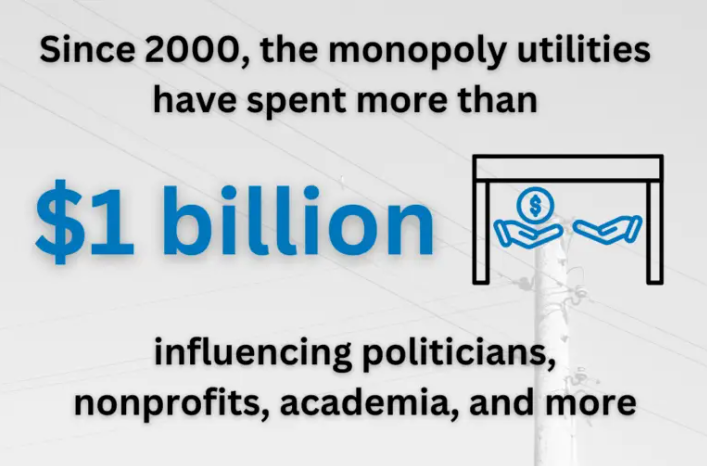
It is because utility interests have spent over a billion dollars since 2000 to nudge politicians, nonprofits, community organizations, academic institutions, and trade associations to presume otherwise, and that $1 billion is just in California!
One consequence of the utilities' using huge money to buy influence at every level and branch of government around the nation is that many regulators & lawmakers either actively repeat the utility lie that rooftop or community-owned solar is responsible for rising utility bills, or passively assume that it must be true since they have heard it so many times.
One example of the utility interests’ reach depicts the scale of the problem. This report from the Public Advocates Office (PAO), a branch of the California Public Utilities Commission, is what motivated McCann’s study cited above. Apparently taking what the utility interests said at face value, the PAO alleged that current rooftop solar customers were causing a “cost shift” of $8.5 billion onto non-solar customers in 2024. That is a $10 Billion dollar difference from the cost saving that M.Cubed found!
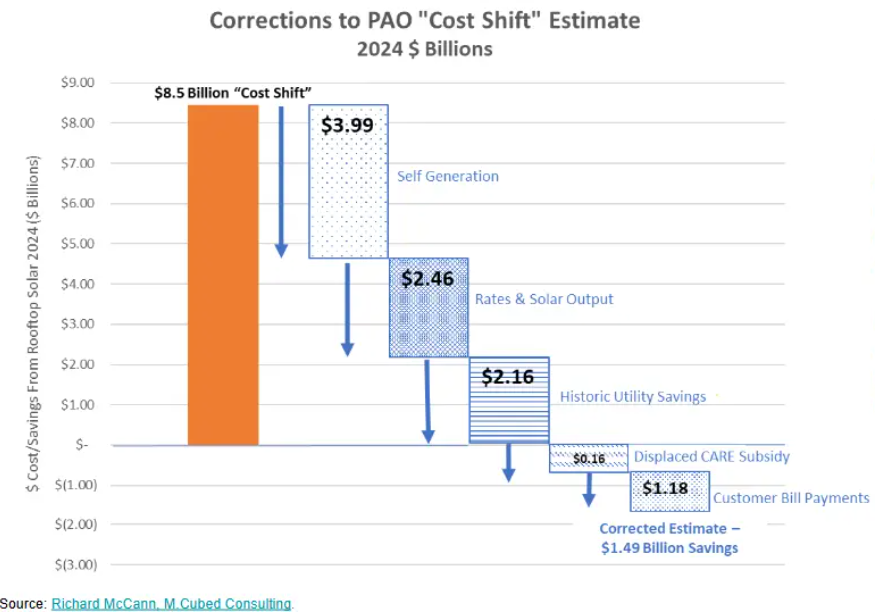
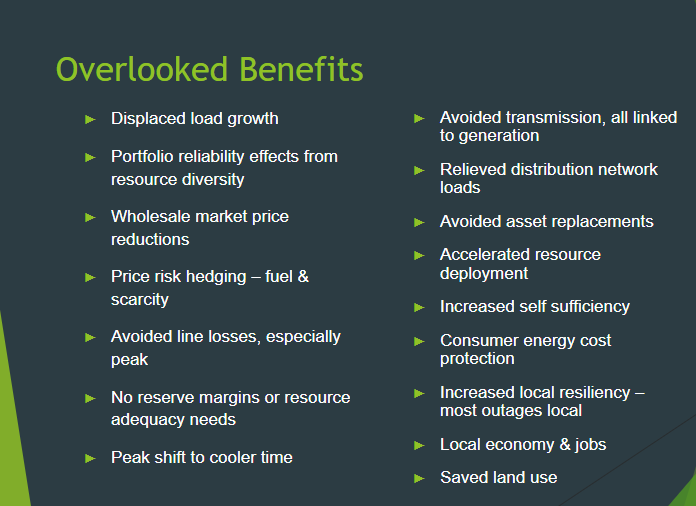
This allegation of a cost shift happening shows a myth-making pattern, as described by the Institute for Local Self-Reliance in 2023: 1) Exaggerate the costs of non-utility owned solar (or fabricate costs that don’t exist), and 2) Ignore the social benefits and avoided costs that it provides.
HOW THE SOLAR COST SHIFT MYTH ORIGINATED:
This was no accident. The cost shift myth was carefully crafted by the utilities’ national trade association, the Edison Electric Institute, back in 2012 & 2013. In their paper titled “Disruptive Challenges: Financial Implications and Strategic Responses to a Changing Retail Electric Business” they refer to distributed energy resources as a “disruptive force” to the traditional utility business model. It wasn’t a coincidence that the Disruptive Challenges paper came out when it did.
During its early days, solar was a premium niche product for consumers willing to pay more, and 2012 was right about the time solar energy became cost competitive. But around 2012, solar was shifting from being an exclusive Whole Foods of Energy to becoming the Costco of Power (as Bill McKibben has eloquently put it). It is something customers could buy in bulk to SAVE on the utility bills, a way for middle-and-working class families to have air conditioning without breaking the bank.
The chart below shows the majority of solar adopters in Minnesota are under $170,000 in household annual income from a data visualization tool.
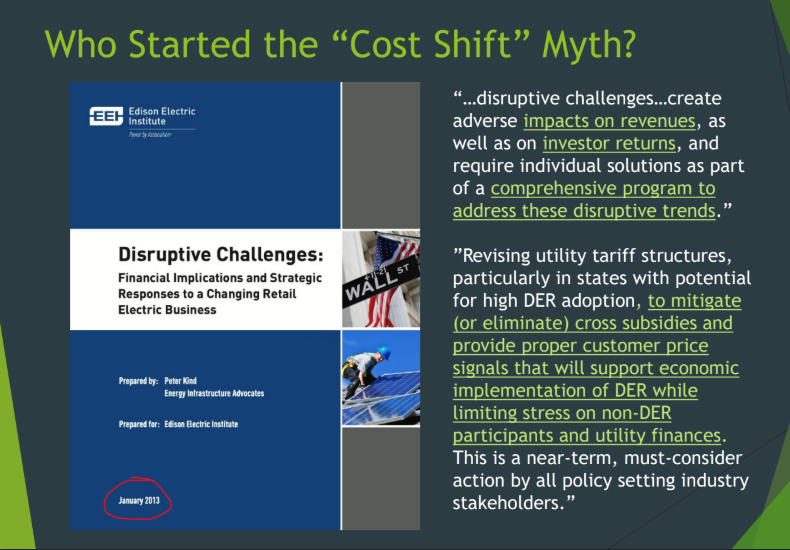
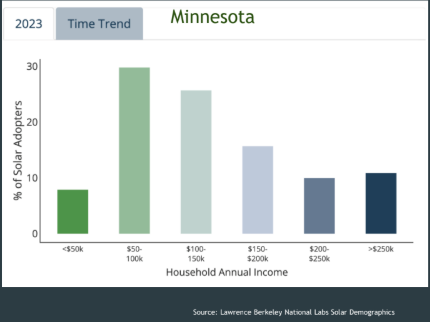
Through this market evolution, we can see that the end game of the solar cost shift myth is to try to move non-utility owned solar energy back into the Whole Foods category, a limited boutique niche and no real threat to the utilities’ market share. Again, as this paradigm shifts and normal folks use solar power to save on their utilities, it threatens to go mass market, growing into the feared “disruptive force” to utility market share.
HOW WE HAVE SEEN THE SOLAR COST SHIFT MYTH PLAY OUT IN MINNESOTA:
While we’ve shared information about the following in past blogs and newsletters, it’s that time of year again. This blogpost is preparation for the expected new iterations of the cost shift myth due to arise from Minnesota state legislators in their session and the utility lobbyists working to confuse them. The stakes are high for smashing this pernicious myth, given the current ballooning demand in electricity, driven by data centers and new non-human actors like Grok, Claude, Chat GPT and their ilk.
Attacks on Community Solar
For years, Community Power has watched Xcel Energy lobbyists use a version of this myth to try to undermine Minnesota’s community solar program at the State Legislature and at the MN Public Utilities Commission. On February 15th, 2024, the MN Public Utilities Commission was so convinced of a version of the solar cost shift myth that they made the unusual move to retroactively alter the terms of 25-year contracts, mid-stream, so that they could slash the bill credit rate for subscribers to early community solar garden projects. Community solar offers a way for households who can’t put their own solar on their own rooftops to participate in the clean energy economy, where the credits subscribers receive from the utility more than compensate for the fees subscribers pay to a community solar developer – As a rule, the savings for qualifying Low and Moderate Income subscribers are 20% and for non-qualifying people 10%, but we digress.
Also, in 2025, a bipartisan group on the MN State Senate Energy Committee was so convinced of the solar cost shift myth that they voted to advance a bill to sunset Minnesota’s community solar program. Our renewed thanks to all involved for helping guarantee that the bill ultimately did not advance in the State House.
Attacks on Net Metering
This year, yes, in 2026, the rumors are flying that there will be another attempt to weaken Minnesota’s net metering laws coming from the Minnesota Rural Electric Association (MREA), who actively used the solar cost shift myth to try to do so last year.
Let us remember, ending net-metering is a policy move that would essentially stop small-scale rural solar installations in Minnesota!
Net metering is when a solar owner receives a fair credit for the electricity they deliver to the electric grid, for providing electrons that their neighbors purchase from the utility. Without net metering, the utility would pocket an unjust part of that money and essentially profit off of other people’s, yours and mine perhaps, investments in clean energy.
If community and rooftop solar is already in your neighborhood then you and your neighbors will use it. The electrons made by the solar panels go to the nearest load or use point. The solar homeowner or solar garden developer has already done the work of bringing the generation source close to you. So that means none of the costs of new transmission lines should be assigned to these local electrons.
To illustrate what the cost shift myth looks like in action, it is helpful to provide an example.
Here is an op-ed written by someone who states the solar cost shift myth directly at the end of the 4th paragraph to argue for weakening net metering laws, calling that a “pragmatic reform.” What is interesting is that the author simultaneously gives the impression of being pro-renewable power in general. So that way, energy decision makers and organizations who are generally supportive of renewable power would be receptive to the message. The author (and many others like him) manage to bridge that gap and make that pivot by claiming that utility-scale solar is “more efficient” and “less expensive” than rooftop solar. Even though the costs of rooftop, community and utility-scale solar are actually roughly similar, the utility interests make cost-comparison calculations that leave out delivery costs and shareholder profits to make utility-scale solar appear to be significantly less expensive.
So, that leaves us with two things that are needed in response:
1) Directly unmasking and debunking the solar cost shift myth.
2) Addressing that “why don’t we just do utility scale solar instead” pivot.
UNMASKING AND DEBUNKING THE SOLAR COST SHIFT MYTH:
The solar cost shift myth alleges that: Solar projects that are owned by customers or communities create new costs for the utilities which they have no other choice but to shift onto non-solar customers (unless legislators or regulators either make them pay punitive fees or take away their incentives).
If that makes no sense to you, then congratulations! It means you are more reality-based than those who take this bad faith, self-serving ploy by utilities and try to dress it up as financial analysis.
Of course non-utility owned solar power does not increase costs to utilities, nor should utilities disingenuously pass non-existent or fabricated costs on to customers. –The marginal connection fees they may incur are paid for by solar owners during the permitting and pre-installation stages.
The solar cost shift myth itself is based on a few different assumptions that fall apart under greater scrutiny:
1) Utility interests have a tendency to exaggerate their fixed costs by conflating them with grid expansion projects. If the utilities can make their fixed costs look larger than they are, then it provides a platform for them to attack rooftop and distributed solar. Otherwise, the utility interests would not have a basis to make a cost shift claim that other ratepayers are forced to pick up a larger share of something. Fixed costs are those that do not vary with energy usage such as the administration of metering and billing, along with the maintenance of existing infrastructure. A utility making a choice to build a new coal plant would be an example of a grid expansion project and not a fixed cost because it depends directly on projected electricity usage. If the utility can’t make a case that electricity demand is increasing, then they have a harder time making the case to get regulatory approval to build it. But once a utility builds a grid expansion project, then that investment gets added to the rate base. Then the initial cost of these investments is gradually paid off by utility customers over a period of many years. The utility fixed costs are small in comparison to the costs of large grid expansion projects. While the inclination to exaggerate the amount of utility costs that are fixed is not so much a myth that is used for its own sake, it all becomes relevant to the cost shift myth of when you add in the next assumption.
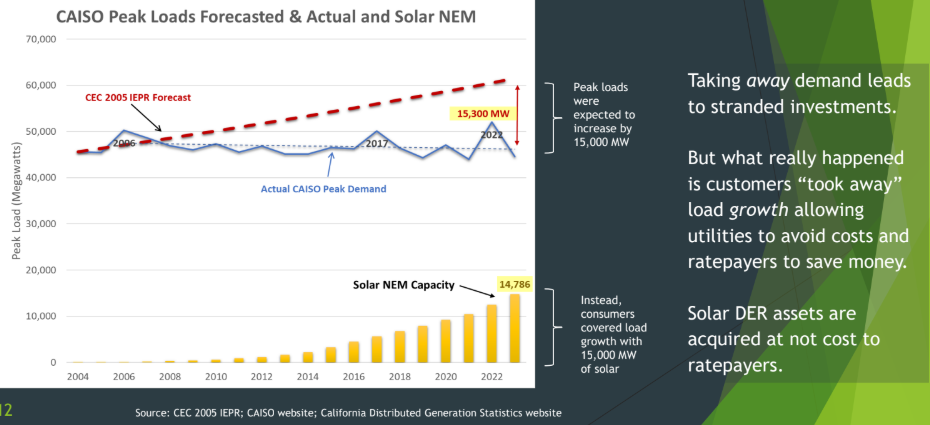
2) The myth of departing load (and the truth that distributed solar shaves peak load!). The myth of departing load alleges that if customers go solar, then they are taking away overall demand for electricity, which leads to stranded costs.
But rooftop and customer owned solar aren't pulling from some fixed pie of utility energy consumption. The reality is that customers and communities going solar constrains the growth of that pie. That is something which allows the utilities to avoid costs and save ratepayers money.
Rooftop and community solar does not cause departing load. It helps avoid load growth. Even without batteries, distributed and community owned solar is effective at shaving peak load. (Peak load is the amount of electricity that utilities have to supply to meet the moment of the day and the year when electricity demand is at its highest). Distributed solar generates electricity on hot summer afternoons when it is needed the most - the times when a lot of air conditioners are running all at once. The investments that solar customers make help the utilities avoid making expensive grid and generation investments that they would otherwise have to do to keep the power on when the grid is most stretched to capacity. Distributed solar assets are acquired at no cost to ratepayers, and they displace the need for utilities to build new generation capacity, which lowers costs for everyone.
- Tying together the myth of departing load with exaggeration of fixed costs: Because the above information directly conflicts with the solar cost shift myth, those who invoke it are counting on their audience not knowing the above described basics about energy utility economics. Those who invoke the cost shift myth try to misdirect your attention like a sleight of hand magician.
- But here is what is really going on:
-
- 1) Having a high peak demand/ peak load drives grid expansion projects.
- 2) Utilities directly profit from building more grid infrastructure to deliver more electricity.
- 3) So therefore, anything that lowers peak demand lowers utility profits and vice versa.
- It is much better to change the incentives of utility companies. We already did so to address energy efficiency. There was a time when energy utilities opposed energy efficiency measures because their profits were tied directly to their volume of sales. Then we saw a new policy tool get implemented called decoupling, where utilities would not obstruct efforts for more energy efficient light bulbs, for example. It is now fairly standard, and often in state law, for utility ratepayers to subsidize their utility’s energy efficiency programs. Utilities such as Xcel have taken credit for their energy efficiency efforts that have saved them from having to build a certain number of power plants. So what is standing in the way of distributed solar being plugged into the same line of reasoning? The reason is because decoupling made capital-intensive grid infrastructure projects (rather than raw KWH sales) into the new central front for utilities to expand their profits. We desperately need utility companies to update their business models to accommodate the changes we need to make. Performance-based regulation (PBR) would be a better system for accommodating distributed generation, but utilities and government have been slow to modernize.
- Here is how utilities profit under the outdated incentive system: Investor-owned utilities expand their profits by their customers paying them monthly utility bills that include a Commission-authorized rate of return on their capital investments. Electricity rate setting, “ratebasing,” is regulated by the Public Utilities Commissions and Public Service Commissions (depending on the state) who guarantee utilities’ Return on Equity (ROE) for all the stuff they build. This has been the utility regulatory compact for decades: 1) Utility companies (regulated monopolies) have to get regulatory approval for the rates they charge customers and for grid expansion projects they want to build. 2) Utility customers are on the hook and obligated to pay off the costs of a utility grid investment month after month on their utility bills over years. That is a segue to the next myth.
3: The concept of lost revenue - This is the odd notion that if anyone does anything that the utilities allege costs them revenue, the utility is then entitled to the money that they would have otherwise made. When you tie that into the myth of departing load, customer-owned solar arrays are labelled as unfairly taking something away from the utilities. This is not an abstraction but poses real-life consequences. Alabama Power, for example, has been imposing fees of about $300 per year for having solar on your roof. In sum, the very manner in which the utilities label customer (non-utility owned) solar as “departing load” carries an air of monopolistic entitlement. It is a presumption that the utilities have some inherent right to own a customer’s energy consumption.
The monopoly status of utilities does not extend behind the meter to cover electricity that a customer doesn’t buy. Where is there any example of any business that gets guaranteed revenue from people who are not buying their product? Insisting on a monopolistic one-way power flow from utility to customer simply because that’s how things have been done in the past is a relic of outdated thinking. Utilities were granted monopoly status many decades ago because it was redundant and expensive to have multiple companies building parallel sets of poles and wires. It was not intended to grant the utilities the sole responsibility, or birthright, for generating energy. It just happened that during the central station era, before solar enabled customers to self-generate, only the monopolies had the capital to participate in energy generation.
- Utilities want to be shielded from the consequences of unwise past business decisions: Utilities (and regulators) have frequently made the mistake of choosing to build large-scale, fossil fuel power plants because protecting their market share, and perhaps ignoring the voices of advocates who foretold wind and solar becoming cost-competitive. Rather than having shareholders eat the consequences of those unwise decisions, utilities, through varying degrees of regulatory capture, force their customers to pay off the sunk costs of the old energy system, even if they are building new renewable energy systems at the same time. Renewable power opponents use that slight of hand to try to blame renewable power as being responsible for rate hikes and not sharing the full picture, and instead pointing to a false assumption of renewable power as inherently more expensive. A central question that highlights the monopolists’ sense of entitlement: Does the utilities’ “obligation to serve” mean they are guaranteed risk-free investments?
Takeaway #1 (and don’t forget it): There is a fundamental divergence of interests between profits for utility companies and rates for utility customers. Utilities have an incentive to spend big on infrastructure projects because that is how they expand their profits. But more profits for them means more rate hikes for customers who pay for all new projects. When people use less energy, or do more solar self-generation, the utilities don’t need to spend as much on poles and wires, andhile that saves ratepayers money, it also cuts into utility profits.
Solar self-generation does not incur some mountain of additional generation or transmission costs for the utilities that they have to divide up and recoup. Customer-owned solar and community solar threaten utility profits because utilities make money by building and owning power plants and power lines. Therefore, saving billions of dollars of infrastructure spending should help lower rates. But spending less on poles and wires cuts into utility profits.
In 2019, the Institute for Local Self-Reliance estimated that Xcel shareholders had missed out on over $100 million in earnings due to non-utility ownership of the then-500 megawatts of community solar. Customer-owned or community solar generated behind the meter is not departing load and does not automatically create costs. The utilities only treat it that way because it reduces demand for such utility investments. But the utilities won’t publicly admit that because it would be bad PR. So instead, they accuse it of raising rates for non-solar customers.
Ergo: Those who invoke the cost shift myth are privately concerned about utility profits but publicly claim to be concerned about ratepayers, though there is at least one instance in Arizona where a utility spokesperson said that quiet part out loud.
Takeaway #2: Utility spending is the real source of rate hikes: The real reason behind utility rate hikes is runaway utility spending driven by the utilities’ motive to increase profit, not customer-owned renewables. In fact, over 90% of the utilities’ rate hikes are a direct result of spending increases on new poles and wires that far outpace what we need. Since 2002, utility spending on transmission and distribution has increased by more than 300%—even though peak electricity demand was relatively flat in that period. For logical clarity, utility spending on grid infrastructure is at a near 1-1 ratio to rate increases. If there were a cost shift caused by fewer customers buying electricity from the utility, then rates would have climbed noticeably more sharply than spending. If there were a solar cost shift, then utility spending increases would be mild compared to a noticeably larger increase in rates.
Also, utility profits went way up despite a 20-year period of flat demand. Both utilities and their regulators knew for years that rooftop solar was reducing peak electricity demand and thereby the need to spend on poles and wires should be reduced. Yet the utilities ignored that and decided to overspend anyway because that is what they are incentivized to do, and the regulators capitulated. The final element for utility rates going up is lax and permissive regulatory oversight in places that have a PUC (or PSC equivalent) that has a tendency to rubber stamp whatever gold-plating the utilities want to pursue. In one case in California, 60% of transmission infrastructure is self-approved, which means the regulators don’t even scrutinize it. When resources are not available to get a transparent public forecast of generation needs, then the utility interests are essentially unchecked by competitive forces.
Conclusion: If you combine all 3 assumptions (exaggeration of fixed costs, departing load, lost revenue) you get the cost shift myth. The conclusion is that non-solar customers would have to step in and pay for the “fixed costs” that solar customers are not paying for. That is unless a legislator or regulator forces solar customers to pay punitive fees (or take away net metering or community solar credits they receive) as the alternative to letting rates go up for everyone else. But third-party, individual and community owned solar generation is not a cost, lost revenue or departing load. These assets, or Distributed Energy Resources, help support electricity demand growth, add to grid stability and are just plain useful. What they don’t do is put money in the utility’s pockets, and thus the rub, the disruption, the desire to create slanderous myths.
ADDRESSING THE SUGGESTION OF THOSE WHO INVOKE THE COST SHIFT MYTH: WHY DON’T WE JUST DO UTILITY SCALE SOLAR INSTEAD?
Now that we’ve seen how the assumptions behind the cost shift myth fall apart, there is an additional insidious aspect of it to be aware of.
The utility interests who invoke the solar cost shift myth are trying to convince an audience of energy decision makers and organizations who are generally supportive of renewable power with a tricky pivot.
The old and outdated divide-and-conquer strategy is when solar critics pit people who care about sustainability against people who care about affordability against each other by insisting that there is some tradeoff where you can only have one or the other but can’t have both. While those inclined to oppose renewable power in general may still presume that the old story must be true, simply because they have heard it so many times, that old story has lost credibility among those who are actually serious about energy policy and think about it deeply once solar costs plummeted.
So the Edison Electric Institute hired a PR firm called Maslansky & Partners to hatch a new strategy of pitting 2 types of solar against each other, utility-scale vs. distributed, preserving that old affordability vs. sustainability divide-and-conquer wedge only for the distributed solar side. They invert reality by painting utility-owned / utility-scale solar as “universal solar”, and “solar for all,” while painting rooftop solar as only benefiting a limited number of owners who impose higher costs for everyone else.
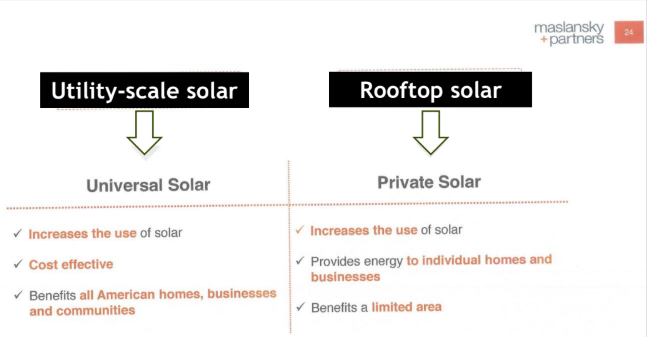
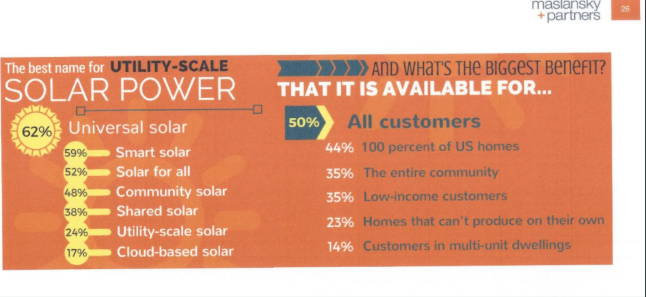
Even before that, back in 2014 or 2015, Xcel Energy ran commercials depicting utility-scale solar as “solar done right.” It was Xcel’s natural response to Minnesota’s 2013 community solar law attracting far more project applications than they probably anticipated. In those ads, Xcel was subtly declaring that they should be the ones who provide solar power –and should have the privilege of moving solar to being the Costco of Power. It matches how we have heard lobbyists for Xcel claim that utility scale solar is more “cost effective” and “accessible” when trying to nudge energy decision makers to undermine community solar.
There are a couple of new twists that they use to make community solar look less cost efficient than utility scale solar. The first is the Locational Marginal Price (LMP), which is not a fair comparison, because LMP is wholesale and a mix of different types of generation that doesn’t include the value of local clean energy or the cost of delivering power through the distribution grid. The second one is using the fuel clause fallacy to compare the wrong costs making community solar look more expensive than it really is. They compare the full cost of community solar (development, construction, maintenance, operations, etc.) to only the fuel portion of fossil fuel generation where obviously a whole slew of costs had gone before.
Xcel may also explain that rooftop or other distributed solar doesn’t pay its fair share for the lengthy transmission lines that connect cities and towns to the central station plants, but locally sited solar never uses the transmission lines. Thanks to physics, those electrons get used by the nearest load, your and your neighbors’ houses. The truth is that we need both types of solar, both distributed and utility scale solar, especially where it can replace older generation sources like coal, fuel-oil and fossil gas.
Response #1: Smaller-Scale Solar has a speed advantage and an avoided cost advantage
The issue is that utility-scale solar projects will get more difficult over time as the best sites are used up and transmission siting challenges cause costs to go up. It made sense for Xcel to do a utility-scale solar project at the site of their retiring Sherco coal plants, because there is already transmission infrastructure in place. But what about places where there isn’t?
It takes 8-10 years to construct new high-voltage transmission lines, and a new central station power plant takes years to design, permit and build. Meanwhile, rooftop projects can be built in weeks or even days, a huge speed advantage. A little hyperbole illustrates the case: If everyone generated their own electricity with rooftop solar, there would be no need for big power plants connected by million-dollar-per-mile high-voltage transmission lines.
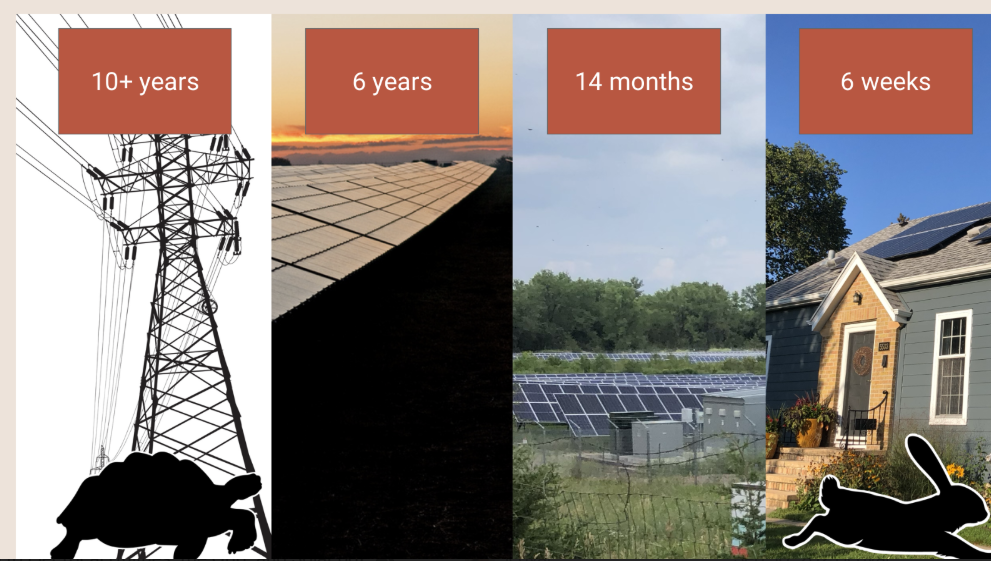
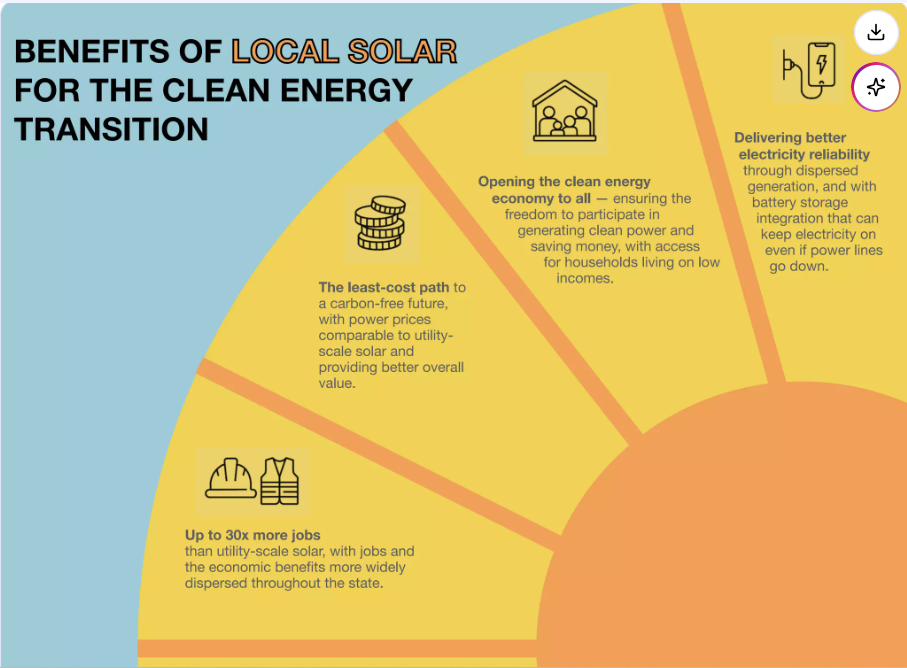
While utility scale, community and rooftop solar all have roughly similar costs as each other (with distributed solar having more benefits), those who invoke the solar cost shift myth exclude avoided delivery costs and shareholder earnings from their calculations to make utility-scale solar appear cheaper. The truth is we need both utility-scale solar in places that make sense and distributed solar in places where it is more strategic. The benefit of solar technology is that it is entirely modular and adaptable to almost anyplace, so why not take advantage of that?
Response #2: Utilities have a bias toward solar that mimics their familiar central station model
Customer and community-owned solar is not the type of infrastructure that utilities can get their 9.25% guaranteed return on investment on (Xcel’s ROI in Minnesota). So as a result, the outdated utility business model has a bias against deploying solar in a more distributed manner because those solar projects are much easier for customers and communities to own. The utilities have a bias in favor of deploying solar generation in a way that mimics their familiar central station model because that makes it easier for them to maintain market share. The huge investment dollars required for projects at such a huge scale makes it far more likely that the utilities will be the ones who get to own, control and rate base it and get that guaranteed ROI.
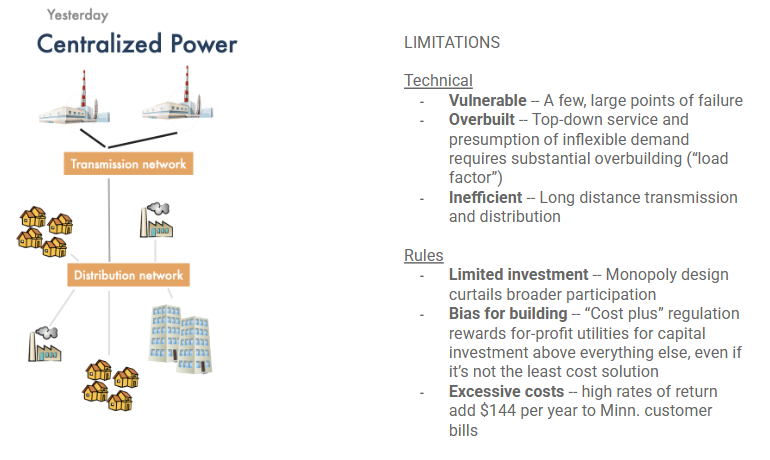
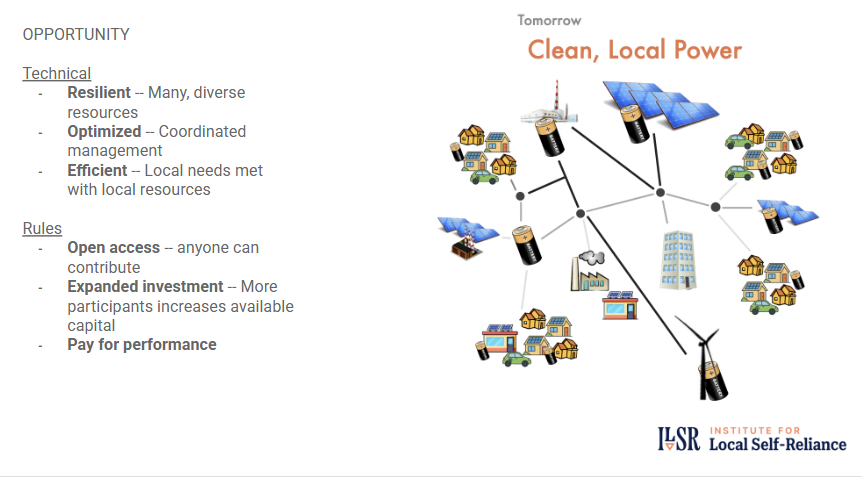
Distributed solar also has a reliability and resilience advantage. If a huge amount of solar panels are concentrated at one site, and a cloud goes over that small area then it causes a disruption in energy supply which the utilities could use to justify the building of more gas plants. Distributed solar will even out the supply and increase reliability but will undermine the utilities’ ability to claim that more infrastructure projects are needed.
Response #3: The Stakes are high given electrification and AI
To state it simply, distributed solar is what we need to meet Minnesota’s 2040 renewable power commitments without excessive costs or delays. We can’t count predominantly on utility ownership, (which often means utility-scale renewables) at the expense of distributed generation without preventable cost increases and most likely delaying state renewable power commitments. Especially now, in our current conditions of increasing demand, we need more distributed local and community owned solar as soon as possible to defray surging energy prices. This demand growth is driven partly by the electrification of gas end-use appliances and transportation, but also by new data centers and the Large Language Models and Machine Learning, frequently shorthanded and marketed as Artificial Intelligence, that “live” there. This is all happening in the context of ever increasing carbon dioxide concentrations in the atmosphere, remember?
It is important for our climate that we power our cars and run our new appliances with electricity that can much more easily be decarbonized than fossil gas and liquid fuels. But far from “solar done right”, stubbornly clinging to an outdated 20th century remote central station model is a recipe for continued runaway utility spending, pushing costs even higher and massive delays. Removing the red tape and leveling the playing field for the cheapest and quickest forms of new energy generation like solar plus storage is essential for meeting higher electricity demand. We need more rooftop and community owned solar – not less – to control costs for all customers and to meet state clean energy goals on time.
CONCLUSION: OTHER PLACES HAVE TRIED IT. PROPAGANDA HAS CONSEQUENCES. WE DON’T HAVE TO REPEAT THE SAME MISTAKES
The California PUC bought into the cost shift myth. As a result, they replaced their best-in-the-nation net metering program with a new “net billing” program that went into effect in the spring of 2023. Immediate result: it caused the layoff of 17,000 skilled solar professionals, an 80% drop in demand, with at least 25 long-standing California solar businesses closing or filing for bankruptcy in 2023 and 2024. That chilled the market for solar and set it back years right at a time when we need more solar like never before.
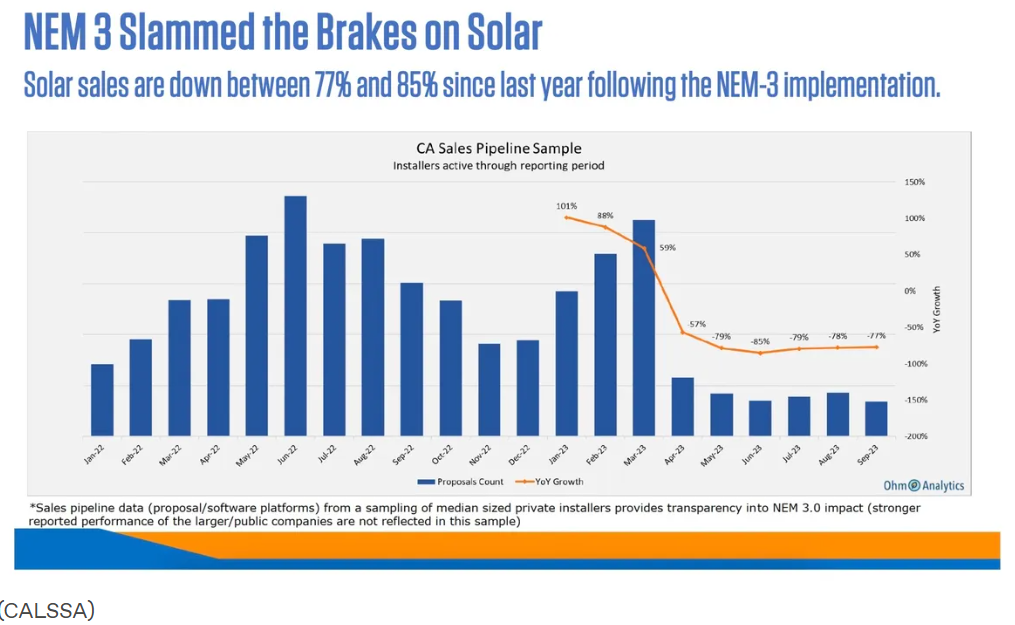
We don’t have to make the same mistakes.
Latest
August 2026 Community Power Newsletter
Posted by Lee Samelson on September 02, 2026
Mayor Frey: Protect the new $4 million for low-income weatherization
Posted by Lee Samelson on August 25, 2026
July 2026 Newsletter and Tribute to Representative Karen Clark
Posted by Lee Samelson on July 27, 2026
June 25th Panel Reveals Pro-Data Center Perspectives That Will Be Used In Minneapolis
Posted by Lee Samelson on July 14, 2026