

By a 10-3 vote on December 11th, the Minneapolis City Council passed the Gas and Electric Franchise Fee Funding ordinances (2025-01061 and 2025-01062). Both are now listed as "Deemed Approved". Since Mayor Frey did not veto either in the timeline that he had to do so, both will now go into effect on April 1st. Mayor Frey returned the ordinances to the city council unsigned typing up some objections in a letter from December 19th that were based on there not being as many months of stakeholder engagement compared to back in 2023. Minneapolis will now have an anticipated $4,000,000 in new funds in 2026 that will go entirely to the Minneapolis Climate Legacy Initiative to work to lower carbon emissions and fight climate change in our city.
Community Power has also covered the earlier parts of the story in a previous blogpost that was updated in November.
More specifically, the new revenue will be dedicated to helping households weatherize and retrofit their homes to reduce energy waste and save hundreds of dollars per year. This is thanks to a Franchise Fees Allocation budget amendment which Community Power spoke in favor of at the December 9th final city budget public hearing. This amendment to earmark the funds toward home energy improvements came about in response to the November 13th public hearing on the overall pair of franchise fee funding ordinances.
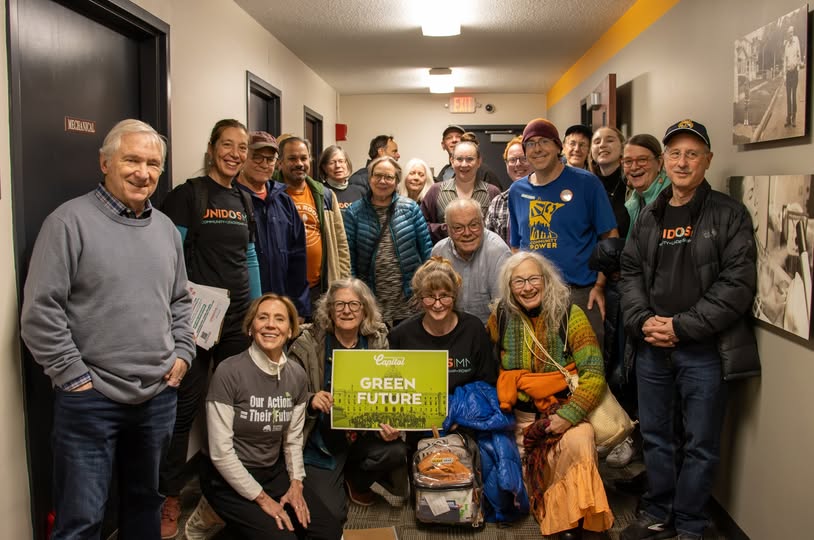
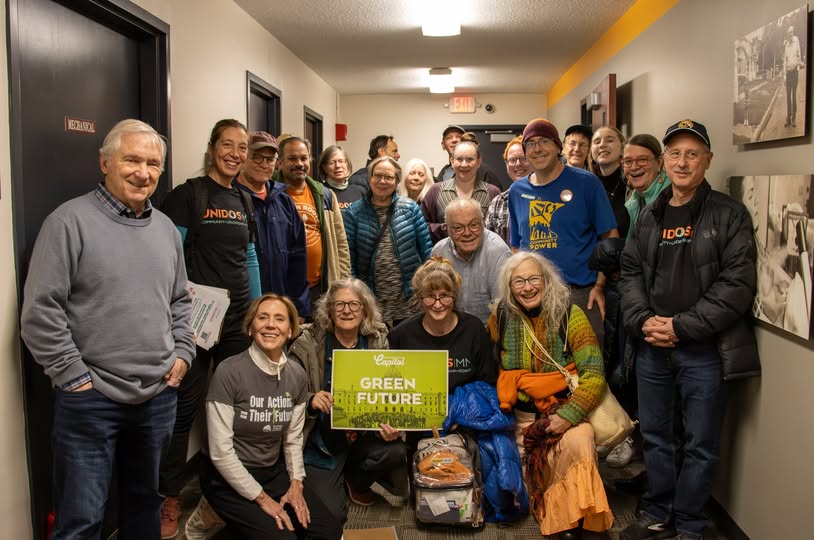 A photo courtesy of Unidos MN taken after the November 13th public hearing
Nearly 60 residents from throughout the city spoke at the hearing, the overwhelming majority being in favor. The small handful who spoke against were from the Downtown Council, Xcel, CenterPoint and BOMA. Notably, dozens among the speakers in favor specifically singled out creating more resources for the city's well-tested energy saving programs like Green Cost Share, as what was most important and meaningful, with priority for households that are low-income and/or in Green Zones.
Ever since our first full year as an organization in 2014, Community Power has spoken at every city budget public hearing advocating for the city to resource equitable climate action on a scale that will truly matter. However, ever since the first franchise fee allocation to climate action back in 2017, we have also consistently and firmly expressed to City officials one additional consideration. Funds which come from a pass through on our energy bills should be dedicated toward opportunities that equitably put downward pressure on utility bills, if made use of.
The new franchise fee rates, which are a percentage of our total Xcel and CenterPoint bills in Minneapolis will go into effect on April 1st, because of a law requiring a minimum notice period. Our current utility franchise fees will increase by 0.25 percent for residents and up to 1.01% for commercial and industrial properties. As a result of this change not going into effect on January 1st, it is now estimated to bring $4 million in new revenue in 2026 rather than the $5 million initially announced.
In addition to the public hearing, there were enough written comments to fill 2 documents.
In the first batch of written comments, Community Power submitted one written starting on page 33 and another starting on page 48.
Here is the second batch of written comments.
The Energy Vision Advisory Committee (EVAC) to the Clean Energy Partnership Board approved this statement at their October 2nd meeting:
Whereas, the 2024 annual report shows that the Partnership is of track on
several metrics of citywide emissions reductions.
Whereas, the city's Climate Legacy Initiative programs have insufficient funds
to meet demand.
Whereas, Past CLI programs have shown success in delivering economic and
emissions savings for customers and community, previously.
Therefore, EVAC supports an increase in the city's franchise fee to support
Climate Legacy Initiative funding to be used in ways focused on reducing the
energy costs of Minneapolis residents and businesses while reducing
greenhouse gas emissions.
Related Budget Amendments at the December 5th City Budget Markup Hearing
On December 5th, the city council held a budget markup hearing that included 3 different amendments that affected the work of the Minneapolis Climate Legacy Initiative - which were titled as amendments #3, #4, and #6 in this packet. Community Power spoke in favor of each of these amendments on December 9th, even though they were all unanimously passed on December 5th.
Here is a list of timestamped videos for the city council discussing each amendment:
Amendment #6. Cashman, Chughtai, Koski – Franchise Fees Allocation
- CM Cashman introduced and read Amendment #6 which allocates the the new funding contingent on the new franchise fee funding ordinances. She cited how close to 60 people came and spoke at the November 13th public hearing where so many of the speakers expressed the same wishes that the new revenue is needed and should be allocated toward high ROI home energy improvements that reduce energy burden.
- CM Jenkins weighs in asking about whether Low Income Households were the beneficiaries of the existing city funds for home energy improvements (which is addressed by Amendment #4). Then CM Palmisano weighed in by clarifying how there are 8 goals of the Climate Legacy Initiative with Healthy Homes & energy improvements being just one of them, asking why this one was picked as a favorite. She then spoke in approval of Vetaw’s Amendment and followed that up with a question on whether the earmark is going to the program itself or to a specific vendor. CM Cashman responded to that question. Then CM Palmisano asked a second question about whether we will need more vendors in order to make use of the new funds. Patrick Hanlon answered that question saying that they would be open to new vendors.
Amendment #4. Vetaw – Utilities and Energy Assistance
- CM Vetaw wrote and introduced Amendment #4 in order to set aside $150,000 for organizations to provide ongoing outreach to residents to offset costs with utilities. CM’s Chughtai and Cashman then answered Vetaw’s question on whether it is tied to the franchise fee funding ordinances. We recognize the vast landscape of energy saving programs can be confusing with many front doors, and resourcing the work to make engagement with these opportunities clear and simple for residents is essential for making sure that the resources can meet vulnerable households in most need.
Amendment #3. Osman – Zero Waste Program Manager + Work Group
- CM Linea Palmisano weighed in on the funding for Amendment #3 should come from the Climate Legacy Initiative or from public works solid waste and recycling.
- CMs Cashman and Chowdhury then weighed in taking a position that it is important that these funds related to Zero Waste not come from money due to franchise fees because it is not an activity that directly lowers utility bills.
Many multifamily businesses and residents don't have access to composting yet, and the City's recycling rate declined by 1% last year. That does not put us on track to meet the goal of 80% recycling and composting rates by 2030, set by the Zero Waste plans of 2017 and 2019. So this work is more important than ever if we are to close the HERC and not expand landfilling.
Which city council members voted which way on December 11th, along 8 providing their explanations as to why
At the December 11th city council meeting, 8 out of 13 council members expressed their views on the Gas and Electric Franchise Fees Ordinances after they were introduced by CM Cashman.
Click on the names below to hear what each had to say:
- Andrea Jenkins:
- LaTrisha Vetaw:
- Linea Palmisano:
- Aurin Chowdhury:
- Jason Chavez:
- Katie Cashman (responding to previous speakers):
- Elliott Payne:
- Jamal Osman:
- The Roll Call of Vote: Councilmembers Palmisano, Vetaw and Rainville voted no with all other 10 councilmembers voting yes.
It is no secret that the ideal way to fund equitable climate action would be to have fossil fuel companies pay for remediation directly. Since we don’t have that yet, the way the city has been able to structure the franchise fees to limit the costs of low-income and residential households and small businesses as well as the strategy of concentrating outreach in the green zones and among low-income households.
Some city council members listed above have pointed it out on multiple occasions that ideally, we would have robust funds coming in from the state and federal levels of government due. But the federal government is even slashing the funds that were supposed to go to Community Power to do the same energy efficiency navigation work. As a result, enough city council members agreed that the city needs to step up to fill that void in leadership, with a modest proposal. Having an extra $4 million in 2026 and an extra $5 million in future years by itself is not at the scale needed to meet the city's own scientific fair share carbon reduction goals. But it will help address the concern repeated over and over at the November 13th public hearing where the very popular Green Cost Share funding ran out of funding in late summer.
What about a Progressive Carbon Fee?
A carbon fee on large polluters would be more progressive and would more closely resemble the polluters pay model than franchise fee funding.
Council member Robin Wonsley took the initiative on pursuing a carbon fee, by adding Carbon Dioxide to Minneapolis’ Pollution Control Annual Registration (PCAR) fees system. That had been looked at by Community Power and partners as an equitable way to resource local climate & environmental justice.
In a previous blogpost, Community Power announced a report that identified the franchise fee as only one among multiple ways of scaling up resources equitable climate action in Minneapolis.
A new carbon fee is in fact now in place with Minneapolis being the first city in the Midwest to adopt this model. However its effectiveness in raising revenue to significantly cut emissions is hampered by state statute, as recently covered in the Star Tribune.
MN State law limits the rate charged to the city’s 65 largest polluters to the cost of administering the program. While the fee was initially set at $452/ton (which reflects true climate costs) state law restricted it to covering the program costs, not true climate cost. That led to a much smaller fee that was capped at $175k/year. While the intention of the fee is to incentivize carbon reduction, is it too low to change behavior?
Beyond Minneapolis: Local Climate Action Plans
Cities are essential to achieving climate goals! Local governments are responding. 22 Minnesota cities, counties, and regions have now adopted standalone climate action plans. The 100 Percent Coalition has a newly released report that documents this progress across Minnesota and identifies key opportunities to scale high-impact climate action.
The next five years are consequential. Along with getting on track to meet 100% renewable electricity by 2040, Minnesota also has 2030 clean electricity and emissions reduction goals. These can be met with compounding benefits of improving energy affordability, public health, and climate resilience for every community with some additional and continued strategic state investment and coordination.
Latest
August 2026 Community Power Newsletter
Posted by Lee Samelson on September 02, 2026
Mayor Frey: Protect the new $4 million for low-income weatherization
Posted by Lee Samelson on August 25, 2026
July 2026 Newsletter and Tribute to Representative Karen Clark
Posted by Lee Samelson on July 27, 2026
June 25th Panel Reveals Pro-Data Center Perspectives That Will Be Used In Minneapolis
Posted by Lee Samelson on July 14, 2026