In this issue: 

  • Join an upcoming “Connect for Climate” event
  • Petition to protect the new $4 million for energy savings
  • Survey on redrawing Minneapolis Green Zone Boundaries
  • George’s "Empower Hour" interview on Electric Democracy
  • Omar Fateh’s Forum on nuclear power Sept 3rd
  • Panel on Zero Waste and the downtown HERC incinerator Sept 8th
  • MN PUC boosts Xcel profits at our expense: A deep dive by EPI
  • National view on utilities profiting from gold-plating & inefficiency
  • Update on the drafting of data center regulations in Minneapolis
  • Additional Articles & Jobs
  • Geothermal tour of the Sabathani Center
  • Multiple Partner Organizations at the MN State Fair Eco Experience

 Protect Funding for Energy Savings in Minneapolis + Connect with Neighbors in doing so! 


Earlier this month on August 3rd, we shared an action alert to send a message to Mayor Frey to reconsider his plans to divert an estimated $4 Million of new utility franchise fee revenue to the general budget. See updated version of our action alert here which gives a more complete backstory

In sum, the Minneapolis City Council voted 10-3 late last year to raise this additional annual $4-$5 million intended for toward low-income weatherization projects to relieve the energy cost burden. When the popular city-backed programs ran out of funds by late summer in both 2024 and 2025, it left many unable to participate. That was a sign that the original level of new funding from the 2023 Climate Legacy Initiative was not enough. 

The city council will hold at least 3 public hearings for you to weigh in on the city budget. They will create and hold votes on amendments to modify the mayor's original recommended budget proposal prior to taking a final vote on the overall budget.    

We have to organize locally with neighbors to call on our elected leaders. 🌱

To do the base building work of protecting the $4 million and to come up with the best messages to send to city leaders and to, Unidos MN is hosting a series of at least 5 "Connect for Climate" events across Minneapolis in September, organized by city council ward.

Attend the event of your choice by RSVPing here or clicking on the image below to learn a multitude of ways on how you can get involved in making Minneapolis carbon-free by 2040 and build healthier neighborhoods. 


Can't attend? Here is a simple petition action:

Unidos MN also has a petition to the Mayor and City Council which you could sign that is customizable so you can and add your own message. 

Wanting to save on your own energy utility bill? 

Check out Community Power's Good Energy Connections energy navigators project to see which program is best for you. 

Translating climate action into actual results starts with defending our democracy and norms for good governance so we can protect our ability to win the funding communities need. On that note, there is an additional timely piece that Community Power can add in: 


How to weigh in on the redrawing of Minneapolis' Green Zone boundaries by Sept 13th  

A decade ago, Minneapolis established these special environmental zones on the city’s north and south sides. The two Minneapolis Green Zones (Northside and Southside) are place-based policy initiatives designed to improve public health, reduce concentrated environmental pollution, and spur sustainable economic development in low-wealth communities and communities of color that have faced historic underinvestment.

This ties into the Minneapolis Climate Legacy Initiative because the Green Zone boundaries are a way to prioritize where the city directs its resources.

  • Resource Prioritization: Green zones offer a way to best ensure that city programs, funding incentives and green infrastructure investments (such as tree planting and stormwater management) go to the neighborhoods which need them the most.
  • Clean Energy & Efficiency: This includes expanding access to affordable solar power and home/business energy-efficiency upgrades through targeted frameworks like the Green Cost Share Program.

Now, the boundaries are due to be redrawn, and the city wants to hear from you. See more in the article:

"Residents in Minneapolis ‘green zones’ want more benefits, power as city redraws boundaries

  • By Andrew Hazzard, Sahan Journal. August 19, 2026

Complete the Green Zone Map Survey by September 13th, 2026

To make it user friendly, we have a Google Doc of the whole survey so you can see the options side-by-side.  

An example of a map in the survey

In the City of Minneapolis Green Zones redistricting data tool and survey, the data is split into census tracts to evaluate cumulative pollution burdens or social vulnerability across the city. The percentiles (often shown as a normalized rank) indicate how heavily burdened a specific area is relative to all other census tracts in Minneapolis.

Additional Core Purposes and Goals

  • Environmental Justice: Clean up contaminated soil and brownfield sites and actively improve local air and water quality. 
  • Equitable Development: Stimulate green job pathways, improve access to healthy and affordable food, and protect existing residents by working to prevent gentrification and displacement.
  • Community Governance: Empower local advisory bodies—the Northside Green Zone Task Force and the Southside Green Zone Council—to guide policy recommendations directly to the City Council and Mayor.


Donate Now so we can continue our work

Electric Democracy is in Reach!

Community Power founding board member George Crocker appeared on a show called the “Empower Hour” to share the latest about democratizing electricity given the great opportunity of how renewable power is now dispatchable. 

CLICK HERE TO SEE OUR UPDATED ELECTRIC DEMOCRACY BLOGPOST THAT NOW INCLUDES A LINK TO WATCH THE INTERVIEW. We will make use of this messaging when it comes time to spring into action. 

Omar Fateh to host forum on Nuclear Power Sept 3rd

Omar Fateh's office will be inviting four advocates--two in support and two against--to present their case on whether the state legislature should lift the moratorium on new nuclear power plants in Minnesota or not, followed by questions and testimony from the audience.

Minnesota lawmakers did approve $500,000 in May 2026 to fund a comprehensive study on the feasibility of new nuclear power plants and the potential of lifting the state's 32-year-old nuclear moratorium.

To attend, please RSVP at this link here. Since Senator Fateh represents SD62, the event will be in South Minneapolis. The specific location will be emailed the day beforehand to those who RSVP. Security will be provided. Doors will open at 5:30, and the forum itself will begin at 6:00pm.

CALL TO ACTION

The HERC, should we trash it? Forum Sept 8th 

September 8 @ 6:30 pm - 8:00 pm Hosted by the League of Women Voters

County leaders have been made aware by residents that the downtown Minneapolis Incinerator (known as the HERC) poses a big environmental justice concern yet have hesitated to set a firm closure date due to questions about where else our trash will go. Partners in the Zero Burn Coalition counter by making a financial case that we can't afford to keep the HERC open and that setting a firm closure date would finally motivate robust zero waste efforts to divert enough waste from the HERC. In particular, what is the just course of action for our waste in Minneapolis, given that we have had a zero-waste plan on the books for years while progress on recycling rates have flatlined and multifamily housing units still doesn't have access to city composting? See more at event page here

CALL TO ACTION
The Work _______________________________________________________________________

Advancing Energy Democracy
Organizing our efforts to maximize impact and drive change.

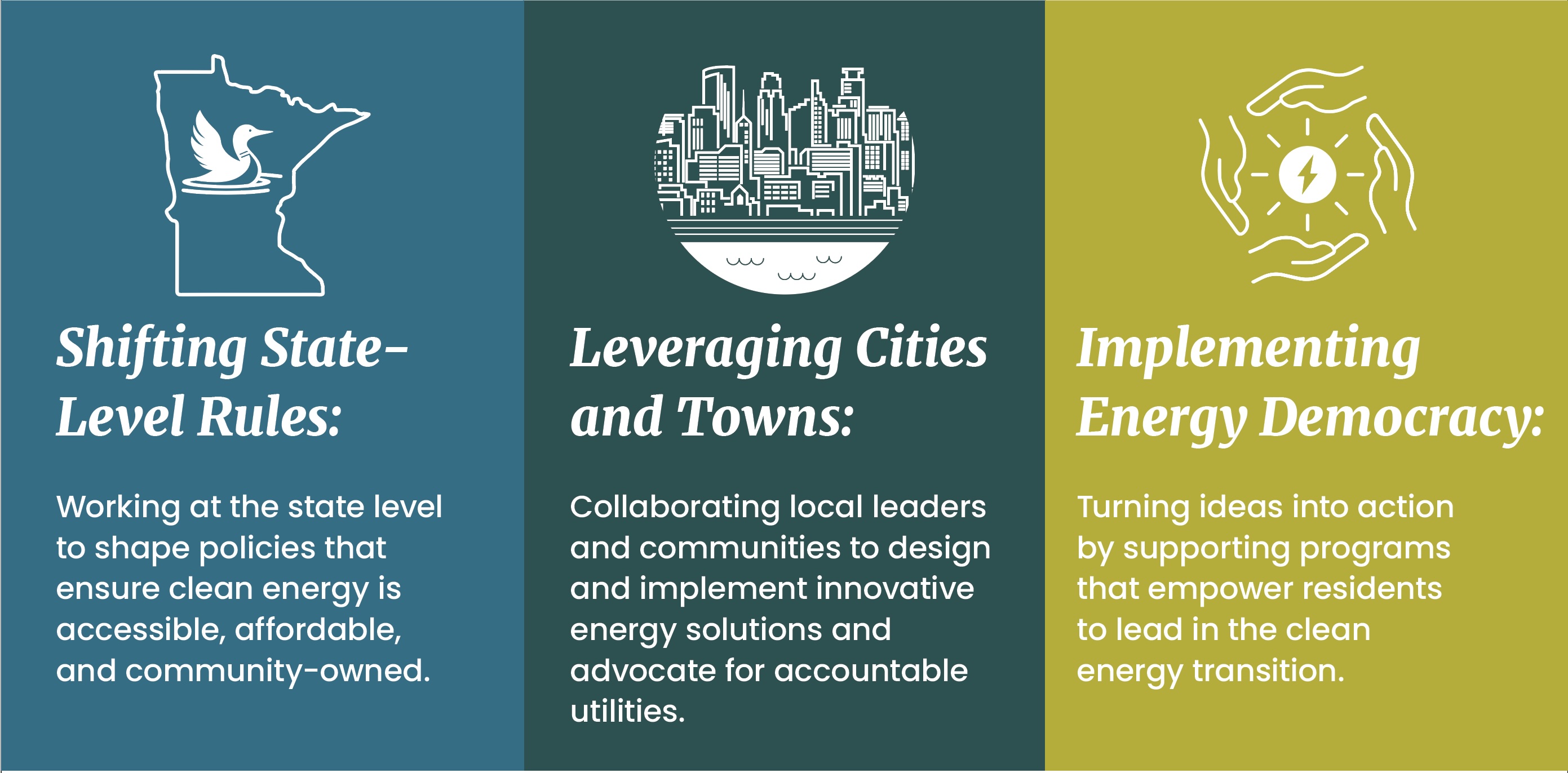
Community Power channels its expertise into three focused program areas. By addressing challenges at the state, city, and grassroots levels, we’re building a sustainable and equitable energy future for all.


Minnesota PUC approves higher Xcel Profits at customers' expense

A new article from Karlee Weinmann with the Energy and Policy Institute Reports dives into this story and showcases how utilities are gaming the system to benefit their shareholders. 

The Minnesota Public Utilities Commission (PUC) issued a verbal decision in June followed by a written order on July 31st to allow Xcel to collect about 5.8% more from its Minnesota customers. That is a $211 million rate increase.

The PUC made this ruling over the strong objections from consumer advocates and Xcel customers, who filed an unprecedented ~8,600 public comments in the proceeding, almost entirely opposing the rate hike. That included the Citizen’s Utility Board of MN (CUB) who has covered the story in depth. CUB argued late fees and reconnection fees should be reduced or eliminated. The PUC did include some affordability provisions in its decision such as approving Xcel’s Power On program. 

While rate cases can get complex, here is one part of it that is straightforward.

On a 3-2 vote, the PUC boosted the guaranteed profit rate for Xcel utility shareholders from 9.25% to 9.6%. This guaranteed profit, known formally as the Return on Equity (ROE), is what enables energy utilities to make guaranteed profits on capital-intensive infrastructure projects such as new power plants and transmission lines. This ROE is included in the base rates charged to customers. As a result, the PUC authorizing what may seem like a small 0.35% increase is actually a substantial profit boost that could cost customers an extra $35 million per year in perpetuity.  According to the Energy & Policy Institute: If a customer has a $100 electric bill, something on the order of $15 of it isn’t paying for electric poles, or wires, or power plants. It’s paying a wealth transfer to Wall Street and the company’s executives rather than improving service.

Every expert who testified at the PUC hearing (who is not affiliated with Xcel) recommended that Xcel’s ROE ought to either stay at 9.25% or be decreased. That would both help with affordability for customers while still leaving Xcel with enough ROE to attract capital.

Citizens Utility Board is now reporting that Xcel Energy’s 2026 second quarter earnings are up $142 million compared to 2025, increasing by more than 30% !

Despite that, 3 members of the PUC voted 3-2 to raise it to 9.6%.

As a typical negotiating tactic Xcel originally asked for their Return on Equity to be 10.3%, which is higher than they could justify. So that way, the final 9.6% offer which they ended up being ok with could be pitched as a compromise.  

Update: CUB, the Minnesota Attorney General's office, and the Minnesota Department of Commerce have asked the PUC to reconsider their decision to increase Xcel's authorized ROE. See the petition

This rate case ruling by the Minnesota PUC stands in sharp contrast with actions taken in several other states where governors, legislators, and regulators are investigating utility profits and even pursuing profit caps to provide relief to ratepayers. For example, Pennsylvania lawmakers have gone straight at the utility profit problem plaguing power bills -- capping the utility's profit rate with a bill that would establish a formula for ‘reasonable return’ on equity when utilities pursue rate hikes. These rising costs also led PA Governor Josh Shapiro to launch a new watchdog special counsel to scrutinize utility profits.

In addition, Michigan lawmakers are also taking aim at utility profits.  


The cumulative effect of seemingly small rate hikes every few years adds up to Xcel’s rates increasing by 98% since 2005. That is almost twice the rate of inflation. Meanwhile, Xcel reported $2 billion in profits last year. This is all part of a national picture where Americans’ electric bills are skyrocketing as utilities rake in record profits. For example, Entergy Arkansas is asking for a profit INCREASE during an affordability crisis.

Investor-owned utilities pocketed $244 billion in profit from customers from 2021 through 2024 according to the Energy and Policy Institute. 

In the past, utilities were largely run by engineers whose mission was straightforward: keep the lights on. Today, that mission is very different. Now we see utility monopolies profiting from gold-plating, waste, and inefficiency as seen in this article: 

"Where’s all the f&$*#ing money going?" the Waste and Costs of American Utilities

As the author of this article, Matt Stoller puts it, “They are willing to waste $1,000 to send an extra $60 to shareholders.” Utilities are “truly paid to fritter away money, to gold-plate and waste” he writes. And, if that’s not bad enough, in some states these same utilities can spend your money on political activities.

According to the Energy and Policy Institute, in states where laws prohibit utilities from charging customers for political spending, consumers are saving hundreds of millions of dollars a year. There is no federal law barring private utilities from using our ratepayer dollars for political lobbying and campaign donations since it was repealed in 2005. The CLEAR coalition, which Community Power is part of, is supporting utility accountability legislation to address that. 

See more about the topic in this fantastic video from Robert Reich explaining how excessive utility profits are driving up your bill and concludes by calling for public power campaigns. 


Minneapolis Data Center Regulations:

The 60-Day Public Comment Period is Now Open!

  • See here on how to submit a comment
  • Save the Date: Also, make your voice heard at the public hearing on October 13, 4:30 PM at the Planning Commission Meeting, at the Public Service Center (250 S 4th St). 

Example Public Comment: If there are to be new data centers developed in Minneapolis, they should come with Community Benefits Agreements that include developers paying for placing solar + storage on nearby homes and businesses. This will add clean energy capacity needed to power data centers so we can avoid building new gas plants. 

The city has paused new data center proposals in most of the city until November 21st to provide time to pass new regulatory standards and to update its zoning rules since we are still learning about the impacts of new generative AI data centers on land use in neighborhoods.

Related Story: 

‘What’s in it for us?’ Residents slam data center plans for former Star Tribune printing plant

  • Skeptical Minneapolis residents pack the North Loop Neighborhood Association's planning and zoning committee meeting to hear the first public airing of a developer's plans to turn the former Star Tribune printing plant into a data center on Wednesday.
  • By Cait Kelley and Matt Mikus, MPR News August 24, 2026. 

Mayor Frey weighs in with his position on Data Centers

Click Image above to see video the from CBS News 

Top recommendations thus far:

The Minneapolis city council heard the report back on their staff directive for recommended municipal data center regulations at an Aug 18th committee meeting. Following the presentation. city council members weighed in. It started with Councilmember Aisha Chughtai initiating an exchange about meeting Minneapolis climate goals in the Commercial and Industrial sector.  

CM Chughtai is one of the two city council members who serves on the Minneapolis Clean Energy Partnership board to hold Xcel and CenterPoint accountable to their promises to be "good partners" in fulfilling ambitious climate and clean energy goals. She emphasized these goals could not be met without the Commercial and Industrial sectors. The Minneapolis Clean Partnership is currently in the process of rescheduling their next public meeting, which is expected to be some time in October.   

Some Recommended Proposed Regulations from the report:

  • No new buildings solely for Data Centers, limit new data centers to existing buildings with siting standards that limit impacts on residential areas
  • Conditional use permit required
  • Require project developers to disclose anticipated energy and water use
  • Can’t be the sole use of a property

Major Concerns: 

  • Property owners outside of downtown could request that data centers be allowed throughout the city in our neighborhoods through a rezoning process. 
  • Any data center more than 175,000 square feet of space would be far too much within the city limit and often implies energy uses of up to 80-90 Megawatts. Since data centers increasingly can pack more high-energy computing power into smaller spaces, we will need state law to change for us to regulate by megawatt.

Additional Articles & Jobs 

Job opportunity - Environmental Sustainability Coordinator

Sabathani logo

Sabathani Community Center is hiring an Environmental Sustainability Coordinator.

The Environmental Sustainability Coordinator role will be guiding participants through green job training programs, ensuring they receive the necessary certifications to thrive in the growing field of environmental sustainability. This position focuses on case management, providing individualized support to participants enrolled in training programs, tracking progress, and ensuring successful completion. This position will serve as the main point of contact for participants, offering resources and guidance to help them secure employment in the green sector.

Visit Sabathani's job posting webpage to apply and for more information.


Community Power staff is pictured here with Councilmember Soren Stevenson (who represents the area) and other elected officials on Aug 18th for a tour of Sabathani’s geothermal heating and cooling project that is currently underway. It sets an inspiring example of sustainability, climate resilience, and is an excellent site to build green workforce development opportunities. Of note, the cost of labor went up because they are losing skilled pipefitters to AI data centers

See more on The Background on Geothermal Energy Opportunities in Minneapolis.

Job Boards: 

Open State Advisory Positions:

Join Us in Building a Better Energy Future.

Together, we can create an energy system that works for everyone. Ready to make an impact? Visit our website at www.communitypowermn.org or reach out to us directly today. Let’s create change—together.

Lee Samelson, Kyle Goertz & Alice Madden

PS. If you swing by the Minnesota State Fair, partner organizations including CUB (Aug 31-Sept 4th), the Alliance for Sustainability (Sept 3rd), and Minnesota Interfaith Power and Light (Aug 29th) will make appearances at the Eco Experience building! 

Facebook LinkedIn Instagram Website

Community Power · Minneapolis, MN 55406, United States
This email was sent to [email protected] · Unsubscribe

Created with NationBuilder. Build the Future.


The Work _______________________________________________________________________

Advancing Energy Democracy
Organizing our efforts to maximize impact and drive change.

Community Power channels its expertise into three focused program areas. By addressing challenges at the state, city, and grassroots levels, we’re building a sustainable and equitable energy future for all.


Minnesota PUC approves higher Xcel Profits at customers' expense

A new article from Karlee Weinmann with the Energy and Policy Institute Reports dives into this story and showcases how utilities are gaming the system to benefit their shareholders. 

The Minnesota Public Utilities Commission (PUC) issued a verbal decision in June followed by a written order on July 31st to allow Xcel to collect about 5.8% more from its Minnesota customers. That is a $211 million rate increase.

The PUC made this ruling over the strong objections from consumer advocates and Xcel customers, who filed an unprecedented ~8,600 public comments in the proceeding, almost entirely opposing the rate hike. That included the Citizen’s Utility Board of MN (CUB) who has covered the story in depth. CUB argued late fees and reconnection fees should be reduced or eliminated. The PUC did include some affordability provisions in its decision such as approving Xcel’s Power On program. 

While rate cases can get complex, here is one part of it that is straightforward.

On a 3-2 vote, the PUC boosted the guaranteed profit rate for Xcel utility shareholders from 9.25% to 9.6%. This guaranteed profit, known formally as the Return on Equity (ROE), is what enables energy utilities to make guaranteed profits on capital-intensive infrastructure projects such as new power plants and transmission lines. This ROE is included in the base rates charged to customers. As a result, the PUC authorizing what may seem like a small 0.35% increase is actually a substantial profit boost that could cost customers an extra $35 million per year in perpetuity.  According to the Energy & Policy Institute: If a customer has a $100 electric bill, something on the order of $15 of it isn’t paying for electric poles, or wires, or power plants. It’s paying a wealth transfer to Wall Street and the company’s executives rather than improving service.

Every expert who testified at the PUC hearing (who is not affiliated with Xcel) recommended that Xcel’s ROE ought to either stay at 9.25% or be decreased. That would both help with affordability for customers while still leaving Xcel with enough ROE to attract capital.

Citizens Utility Board is now reporting that Xcel Energy’s 2026 second quarter earnings are up $142 million compared to 2025, increasing by more than 30% !

Despite that, 3 members of the PUC voted 3-2 to raise it to 9.6%.

As a typical negotiating tactic Xcel originally asked for their Return on Equity to be 10.3%, which is higher than they could justify. So that way, the final 9.6% offer which they ended up being ok with could be pitched as a compromise.  

Update: CUB, the Minnesota Attorney General's office, and the Minnesota Department of Commerce have asked the PUC to reconsider their decision to increase Xcel's authorized ROE. See the petition

This rate case ruling by the Minnesota PUC stands in sharp contrast with actions taken in several other states where governors, legislators, and regulators are investigating utility profits and even pursuing profit caps to provide relief to ratepayers. For example, Pennsylvania lawmakers have gone straight at the utility profit problem plaguing power bills -- capping the utility's profit rate with a bill that would establish a formula for ‘reasonable return’ on equity when utilities pursue rate hikes. These rising costs also led PA Governor Josh Shapiro to launch a new watchdog special counsel to scrutinize utility profits.

In addition, Michigan lawmakers are also taking aim at utility profits.  


The cumulative effect of seemingly small rate hikes every few years adds up to Xcel’s rates increasing by 98% since 2005. That is almost twice the rate of inflation. Meanwhile, Xcel reported $2 billion in profits last year. This is all part of a national picture where Americans’ electric bills are skyrocketing as utilities rake in record profitsFor example, Entergy Arkansas is asking for a profit INCREASE during an affordability crisis.

Investor-owned utilities pocketed $244 billion in profit from customers from 2021 through 2024 according to the Energy and Policy Institute. 

In the past, utilities were largely run by engineers whose mission was straightforward: keep the lights on. Today, that mission is very different. Now we see utility monopolies profiting from gold-plating, waste, and inefficiency as seen in this article: 

"Where’s all the f&$*#ing money going?" the Waste and Costs of American Utilities

As the author of this article, Matt Stoller puts it“They are willing to waste $1,000 to send an extra $60 to shareholders.” Utilities are “truly paid to fritter away money, to gold-plate and waste” he writes. And, if that’s not bad enough, in some states these same utilities can spend your money on political activities.

According to the Energy and Policy Institute, in states where laws prohibit utilities from charging customers for political spending, consumers are saving hundreds of millions of dollars a year. There is no federal law barring private utilities from using our ratepayer dollars for political lobbying and campaign donations since it was repealed in 2005. The CLEAR coalition, which Community Power is part of, is supporting utility accountability legislation to address that. 

See more about the topic in this fantastic video from Robert Reich explaining how excessive utility profits are driving up your bill and concludes by calling for public power campaigns. 


Minneapolis Data Center Regulations:

The 60-Day Public Comment Period is Now Open!

  • See here on how to submit a comment
  • Save the Date: Also, make your voice heard at the public hearing on October 13, 4:30 PM at the Planning Commission Meeting, at the Public Service Center (250 S 4th St). 

Example Public Comment: If there are to be new data centers developed in Minneapolis, they should come with Community Benefits Agreements that include developers paying for placing solar + storage on nearby homes and businesses. This will add clean energy capacity needed to power data centers so we can avoid building new gas plants. 

The city has paused new data center proposals in most of the city until November 21st to provide time to pass new regulatory standards and to update its zoning rules since we are still learning about the impacts of new generative AI data centers on land use in neighborhoods.

Related Story: 

‘What’s in it for us?’ Residents slam data center plans for former Star Tribune printing plant

  • Skeptical Minneapolis residents pack the North Loop Neighborhood Association's planning and zoning committee meeting to hear the first public airing of a developer's plans to turn the former Star Tribune printing plant into a data center on Wednesday.
  • By Cait Kelley and Matt Mikus, MPR News August 24, 2026. 

Mayor Frey weighs in with his position on Data Centers

Click Image above to see video the from CBS News 

Top recommendations thus far:

The Minneapolis city council heard the report back on their staff directive for recommended municipal data center regulations at an Aug 18th committee meeting. Following the presentation. city council members weighed in. It started with Councilmember Aisha Chughtai initiating an exchange about meeting Minneapolis climate goals in the Commercial and Industrial sector.  

CM Chughtai is one of the two city council members who serves on the Minneapolis Clean Energy Partnership board to hold Xcel and CenterPoint accountable to their promises to be "good partners" in fulfilling ambitious climate and clean energy goals. She emphasized these goals could not be met without the Commercial and Industrial sectors. The Minneapolis Clean Partnership is currently in the process of rescheduling their next public meeting, which is expected to be some time in October.   

Some Recommended Proposed Regulations from the report:

  • No new buildings solely for Data Centers, limit new data centers to existing buildings with siting standards that limit impacts on residential areas
  • Conditional use permit required
  • Require project developers to disclose anticipated energy and water use
  • Can’t be the sole use of a property

Major Concerns: 

  • Property owners outside of downtown could request that data centers be allowed throughout the city in our neighborhoods through a rezoning process. 
  • Any data center more than 175,000 square feet of space would be far too much within the city limit and often implies energy uses of up to 80-90 Megawatts. Since data centers increasingly can pack more high-energy computing power into smaller spaces, we will need state law to change for us to regulate by megawatt.

Additional Articles & Jobs 

Job opportunity - Environmental Sustainability Coordinator

Sabathani logo

Sabathani Community Center is hiring an Environmental Sustainability Coordinator.

The Environmental Sustainability Coordinator role will be guiding participants through green job training programs, ensuring they receive the necessary certifications to thrive in the growing field of environmental sustainability. This position focuses on case management, providing individualized support to participants enrolled in training programs, tracking progress, and ensuring successful completion. This position will serve as the main point of contact for participants, offering resources and guidance to help them secure employment in the green sector.

Visit Sabathani's job posting webpage to apply and for more information.


Community Power staff is pictured here with Councilmember Soren Stevenson (who represents the area) and other elected officials on Aug 18th for a tour of Sabathani’s geothermal heating and cooling project that is currently underway. It sets an inspiring example of sustainability, climate resilience, and is an excellent site to build green workforce development opportunities. Of note, the cost of labor went up because they are losing skilled pipefitters to AI data centers

See more on The Background on Geothermal Energy Opportunities in Minneapolis.

Job Boards: 

Open State Advisory Positions:

Join Us in Building a Better Energy Future.

Together, we can create an energy system that works for everyone. Ready to make an impact? Visit our website at www.communitypowermn.org or reach out to us directly today. Let’s create change—together.

Lee Samelson, Kyle Goertz & Alice Madden

PS. If you swing by the Minnesota State Fair, partner organizations including CUB (Aug 31-Sept 4th), the Alliance for Sustainability (Sept 3rd), and Minnesota Interfaith Power and Light (Aug 29th) will make appearances at the Eco Experience building! 

Latest

Sep

02

2026

August 2026 Community Power Newsletter

Posted by on September 02, 2026

In this issue:  Join an upcoming “Connect for Climate” event Petition to protect the new $4 million for energy savings Survey on redrawing Minneapolis Green...

Aug

25

2026

Mayor Frey: Protect the new $4 million for low-income weatherization

Posted by on August 25, 2026

Donate now Minneapolis Resident? Send a Message to Mayor Frey: Please keep the new $4 million for low-income home weatherization programs Starting at this exact point in the City Council’s...

Jul

27

2026

July 2026 Newsletter and Tribute to Representative Karen Clark

Posted by on July 27, 2026

One addition to our July newsletter is sharing some memories of former Representative Karen Clark. We were truly saddened to hear of her passing on...

Jul

14

2026

June 25th Panel Reveals Pro-Data Center Perspectives That Will Be Used In Minneapolis

Posted by on July 14, 2026

It is an issue that has attracted a lot of interest and engagement. Roughly 70 people attended a June 25th Community Conversations event on downtown...