10 reasons to restore the $4 million in the Climate Legacy Initiative budget and to dedicate these funds for future years.
Community Power, along with coalition partners and residents from around the city, (and the city itself) worked hard in 2025 to win an additional annual $4 million for weatherization & environmental justice (we have documented this story in detail).
At City Council’s July 23rd Climate & Infrastructure Committee meeting, a city councilmember at this exact point in the video announced the news that the mayor's proposed budget would divert this new $4 million away from its intended purpose and toward the general fund.
What's at Stake: At the September 24th Climate Legacy Initiative Budget Presentation we finally received some granular numbers on how in cuts much each specific initiative would face if the mayor’s plan to divert this new $4 million does not get amended.

Now 2 we have budget amendments to address this which councilmembers Soren Stevenson and Robin Wonsley have announced in their newsletters (linked below).
5 reasons to support the Amendment to restore $2.6 million towards residential weatherization programs for 2027.
-
The city has urgent policy & science-based climate goals. Making steep cuts in climate equity spending in 2027 is dissonant with the city’s own goals that require the most aggressive carbon reduction efforts between 2025 and 2030. In 2019, Mayor Frey and the City Council declared a climate emergency in Minneapolis after 11,000 scientists designated climate change as an emergency. City Staff have presented a report showing how we have fallen behind on meeting our Climate Equity Plan goals.
-
These programs are popular, successful, well-tested and wildly popular. Green Cost Share for example gets oversubscribed each year, running out of funds in August or September. This high demand is why the City Council passed the $4-5 million increase in 2025 on a 10-3 vote. As the direct result of the $4.7 million of the 2023 Climate Legacy Initiative, we saw a dramatic boost to a total of between 1100 and 1200 Green Cost Share projects in 2024 and 2025.
-
Restoring the $4 million is good for building trust in government and basic democratic principles. Meanwhile, reallocating or diverting these funds that were intended to go towards weatherization for energy-burdened households in less than one year breaks trust with residents as well as the small business community.
-
Weatherization and electrification bring local jobs, health & affordability. Decreasing leaked energy, and mitigating indoor air contaminants create good green jobs right here in Minneapolis and make life for residents more affordable, safer, and healthier. This is an incredibly modest investment relative to the costs of damage from climate change that are happening already.
-
This is Easy Win amid Hard Budget Decisions – These investments are reducing energy bills as an offset to the tax levy way to shield residents and businesses of Minneapolis from the need for a higher levy. This is one of the few city-funded activities that offsets property tax increases (by lowering energy bills). If the intention of the mayor's budget is to balance a shortfall and relieve pressure on residents from a rising levy by making cuts...this is arguably one of the worst things to pick. Leaving buildings uninsulated compounds costs.
 
5 Reasons to support the amendment to establish a Dedicated Minneapolis Climate Equity Fund for future years
-
The stated purpose for increasing the clean energy franchise fee has always been based on the return of funds to customers through weatherization and clean energy opportunities that would reduce utility bills. In the mayor’s proposed budget, the City keeps these franchise fee funds, but this portion would no longer be used to help residents and businesses reduce their energy bills. In 2018, 2024 and today Community Power expressed the importance of protecting these funds from getting diverted away from their originally intended use.
-
Keeping the signal clear and steady to customers, small businesses, and workers is essential to build out the jobs, businesses, and trust. Though City leaders have essentially committed in ordinance and in name of the fund for it to be used for climate action the fund is not yet legally protected. The ordinances which raised this extra $ million do not specify the purposes for the funds but simply lay out how much for the city to collect. That's why formal dedication of a fund is essential to prevent these funds from changing winds and whims in City Hall.
-
There has been a groundswell of opposition to these proposed divestments. On September 30th, dozens of residents gathered at City Hall to take a stand for restoring these funds to the Climate Legacy Initiative (photo below from local news coverage). In October close to 20 spoke at City Budget Public Hearings asking the City Council to create an amendment to restore this funding. Also see the article: Minneapolis climate program advocates push back against proposed budget cuts by Alanna Elder, MPR News Oct 19th, 2026,
-
Delay is Extremely Costly - The longer we delay climate action the worse the costs become. Delaying investment in mitigating climate change is not delaying the same risk. Delaying action is COMPOUNDING risk. Rising instability means we also have fewer and fewer spare dollars to mitigate rather than simply repair damage. As economists and scientists have said: the value of avoiding the impacts of climate change through mitigation is so great (and we are so behind) that there is quite literally no limit to how much policymakers can spend on well-calibrated climate action. It's all saving us. Not just our lives. But our $$$ - even if that's all we're talking about.
-
Federal support for this work is on pause and Xcel’s rates are going up - Xcel Energy just got a rate increase and received $2 billion in profits last year alone. We can't rely on waiting for the feds or the utilities. We must protect, insulate, and do it ourselves.
 
|




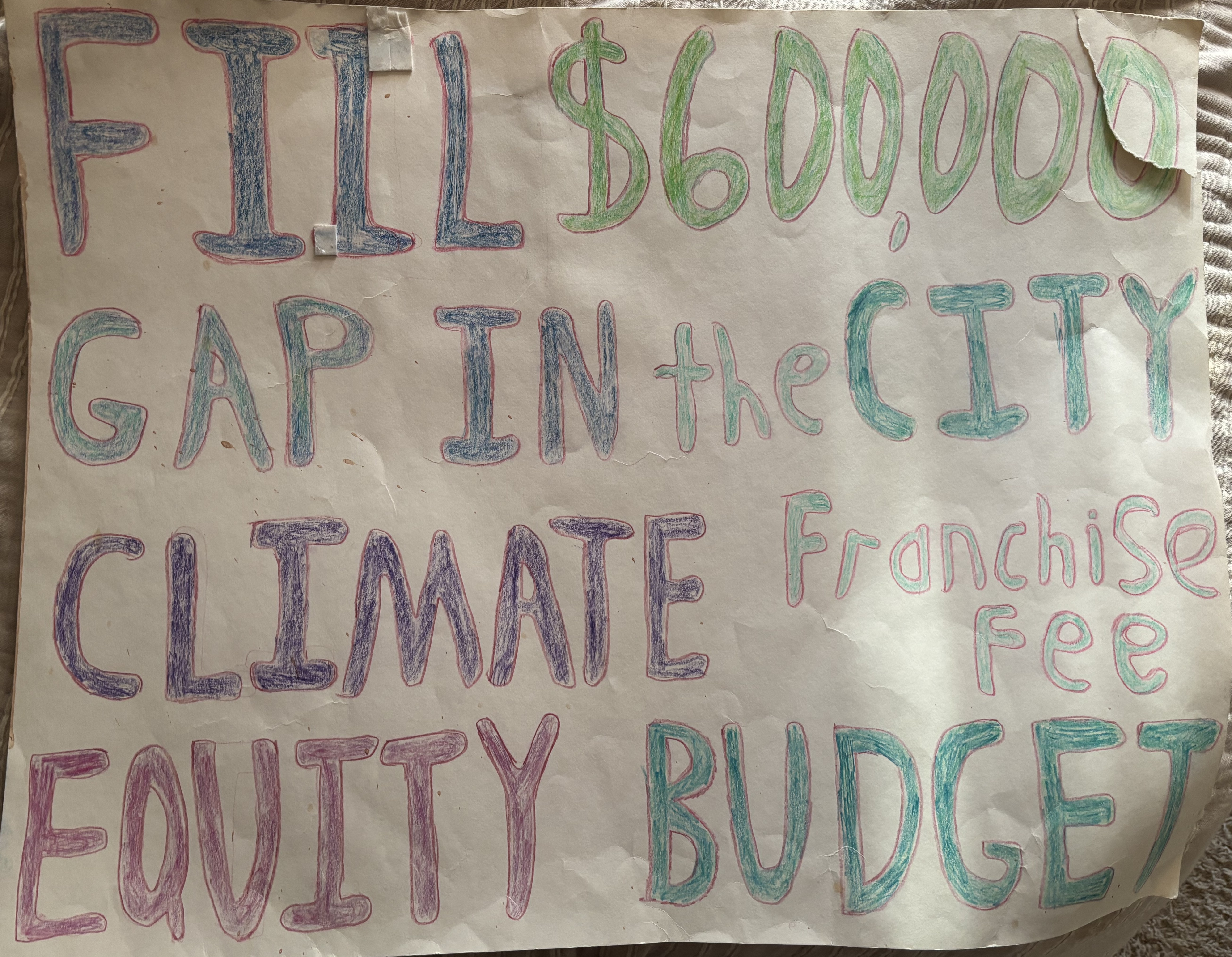 The sign we created in 2019 for the city budget hearing occasion.