
Minneapolis Green Zones Addressing Environmental Justice

Low-income communities, indigenous communities and communities of color in Minneapolisexperience unequal health, wealth, employment and education outcomes and are also overburdened by environmental conditions such as traffic and stationary pollution sources, brownfield sites, blight and substandard housing.
The idea for developing a Minneapolis Green Zone initiative came from the Minneapolis Climate Action Plan Environmental Justice Working Group. A Green Zone is a place based polity initiative aimed at improving health and supporting economic developing using environmentally conscious efforts in communities that face the cumulative effects of environmental pollution, as well as social, political and economic vulnerability.
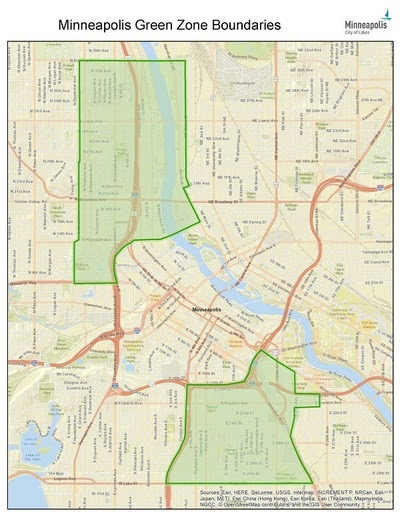
The South Side Green Zone Task Force was created by the City Council Resolution Designating Green Zones on April 28th, 2017. The role of the Task Force is to develop an action oriented Work Plan specific to the South Side Green Zone which includes the greater Phillips community and Cedar Riverside neighborhood (see map below). Since October the Task Force has been meeting monthly and will have a Work Plan draft completed by May 2018. Along with the Task Force monthly meetings Hope Community and the Land Stewardship Project have been holding community engagement sessions to gather input and community concerns, ideas and dreams. Before the Work Plan is brought to City Council in June or July for approval there will be time for community input and reflection. The Task Force has been looking at four main topic areas:
- Air, water and soil quality
- Healthy food access
- Health and energy in housing
- Equity, anti-displacement and green jobs
The Sustainability Division is continuing to work with community partners to consider the initiative’s next steps, how to maintain momentum once the work plan is approved and how to continue an authentic partnership between City and community.
For the Northside Green Zone the City of Minneapolis is working in partnership with Community Action Partnership of Hennepin County (CAP-HC) to bring on Sam Grant and James Trice of the Public Policy Project and EJCC to lead the Northern Metals Advisory Committee and Northside Green Zone work. Together Sam and James will be kicking off the Advisory Committee within the next month. Once the Northern Metals Advisory Committee has provided recommendations for the budget breakdown of $600,000 dedicated to community asthma and lead reduction work, the City of Minneapolis Health Department and Sustainability Division will transition to looking at the other Green Zone recommendations with the advisory committee. This may involve the same people or may establish a subcommittee or a whole separate Task Force. Since both initiatives focus on air and environmental quality in the same geographic area, they are starting as a united project.
Neighborhoods included in the Green Zone Initiative
Southside Green Zone Neighborhoods: Midtown Philips, East Philips, West Philips, Ventura Village and Cedar-Riverside
Northside Green Zone Neighborhoods: Jordan, Hawthorne, McKinley, Folwell, Near North, Bottineau, Sheridan, Marshall Terrace
Latest
"What About St. Paul?" The New Franchise Agreement Arrives!
Posted by Lee Samelson on September 25, 2026
August 2026 Community Power Newsletter
Posted by Lee Samelson on September 02, 2026
Mayor Frey, City Council: Protect the new $4 million for low-income weatherization
Posted by Lee Samelson on August 25, 2026
July 2026 Newsletter and Tribute to Representative Karen Clark
Posted by Lee Samelson on July 27, 2026